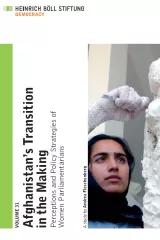
Publication series democracy, Volume 31

Afghanistan’s Transition in the Making

November 29, 2012
Andrea Fleschenberg

Perceptions and Policy Strategies of Women Parliamentarians

Afghanistan's Transition in the Making
Perceptions and Policy Strategies of Women Parliamentarians

At the beginning of the military intervention in Afghanistan, gender-related rhetoric was employed as a source of legitimation for the intervention. Initially regarded as the barometer of success for democratization, today human and women’s rights are in danger of being dropped of the national and international transition agenda. The present study by Andrea Fleschenberg shows that in national and international debates about the transition process in Afghanistan women’s voices are seldom present, or taken into consideration. This is despite women being particularly and most likely significantly affected by the transition process – be it in terms of a possible power sharing deal or a reconciliation agreement between the government and the insurgents or be it in terms of safeguarding the gender specific achievements of the past decade in the fields of education and health. Framed by interviews with women rights activists and women parliamentarians recommendations are lined out for future international policy commitments and responsibilities in Afghanistan.

Publication series on democracy, Volume 31:
Afghanistan's Transition in the Making
Perceptions and Policy Strategies of Women Parliamentarians

A study by Andrea Fleschenberg. Edited by the Heinrich Böll Foundation
Berlin, Nov. 2012, 48 pages, ISBN 978-3-86928-097-4

Copies can be ordered from: Heinrich-Böll-Stiftung, Schumannstr. 8, 10117 Berlin, Tel. 030-285340, Fax: 030-28534109, E-mail: buchversand@boell.de


Afghanistan’s Transition in the Making
   
Editor Heinrich Böll Foundation
Place of publication Berlin
Date of publication November 2012
Pages 48
ISBN 978-3-86928-097-4
Service charge Free of charge


Executive Summary

» German Version of the Executive Summary (PDF)

Afghanistan represents a very particular case of military intervention-cum-statebuilding-cum-democratization with high levels of political and sociocultural violence, ideologically based grievances, intersectional cleavages, a paucity of meritocratic, non-fragmented political elites, and scarcity of a close-knit social fabric in a sustained conflict and insurgency context.

Peace, security, and conflict resolution; democracy and institution-building; human rights and their protection – these are the things that were promised to national and international audiences on either side of the intervention theater at the start of this millennium. In the intervention society itself, Afghanistan, those promises were heard, acknowledged, and taken into serious consideration by actors who intended to pick their chance for sociopolitical change and for an end to the decades-long fighting and violence. Fast forward to late 2012, the same international intervention actors announce that the first transition period is about to be (more or less) successfully completed – so goes the narrative – in order for another one, a locally owned one, to begin. However, 2014 might prove to be a watershed year in several ways, given the announced withdrawal of international troops from Afghanistan and the planned series of crucial elections and their impact on the sociopolitical transition and peacebuilding process in Afghanistan. Questions arise regarding the direction and speed of the transformation, its timing, support in terms of presence (civil and/or military), resources, as well as monitoring and capacity-building by the international community.

(Inter)national debates oscillate between opinions of «too late, too much,» «as good as it gets» / «good enough,» «too early, too little» to «staying engaged.»
In national and international debates, some actors dominate while other voices are seldom present, acknowledged, or taken into consideration, regardless of previous promises and commitments of UN Resolution 1325: namely, acknowledging the voices of Afghan women. At the same time, women will be particularly and most likely significantly affected by the transition process – be it in terms of a possible powersharing deal or a reconciliation agreement between the government and the insurgents; be it in terms of safeguarding the gender-specific achievements of the past decade in the fields of education and health or socioeconomic and political participation; be it in terms of gender-specific vulnerabilities and lack of sustainable support nets. Given the experiences made in previous decades, particularly from the early 1990s onwards, most of those interviewed are of the opinion that the space to lobby for and implement gender equality policies will ultimately shrink and that women’s rights might once again become a bargaining chip for a potential power-sharing deal, thereby circumcising women’s public engagement and access to state institutions.

The fear is of an autocratic regression, a backward transitory cycle, or even a cancellation of achievements. The signs identified are the continuously and increasingly high levels of conflict and incidents of violence against women in areas under transition, and those that have yet to make the transition.

Building on a previous study on gendered aspects of Afghanistan’s political institution-building in 2007/2008, the current study traces the nexus of gender and the post-2014 transition through in-depth interviews with women rights activists and women parliamentarians conducted in Kabul in the first half of September 2012.

Interviewees were questioned on their understandings and perceptions of: (i) issues, concerns, interests, and agendas of the post-2001 intervention as well as the post-2014 transition process; (ii) what «transition» actually means and encompasses; (iii) the impact of the transition process on the recently established political institutions, their work and agendas; (iv) the role of the international community post-2014; along with (v) visions for Afghanistan in 2024, one decade after the supposedly completed withdrawal and another decade of transformation.

Analyzing the perceptions and narratives gathered, a distinct debate about the 2014 transition in Afghanistan crystallizes. Furthermore, a prolonged high level of dependency from external actors and their resources – in a cognitive as well as a material sense – becomes apparent in most of the perceptions and opinions collected, which stands in contrast with the projected intention of local ownership and transfer of responsibility post-2014. Which normative regime and which political actors will dominate in the post-2014 scenario? Can the fragile and precarious steps toward state- and institution-building – including the constitutionally and legally enshrined gender provisions – be maintained and enlarged? Or will there be a reverse trend, a re-directing of the system? Will the precarious public spaces of discourse and agency options for democratization agents survive, allowing for continued activism? What will be the impact of external support, monitoring, and pressure on local and regional events and processes such as elections, peace/power negotiations, or interference from neighboring countries? What will be the legacy of the 2001 international intervention and its impact on Afghan politics and society – another episode of foreign occupation followed by a relapse into conflict and a reversal of changes introduced?

Reviewing the track records of international and national summits, in which transition-related issues were addressed and the role of the international community debated, it becomes evident that a gender-specific transition agenda and women’s concerns were outlined and communicated from a very early stage of (inter)national transition politics. While achievements in terms of women’s political citizenship and basic service provisions are frequently cited as positive achievements of the intervention decade, some question their extent, depth, and viability. Women’s rights and participation in the transition process become thus a litmus test – so far with a rather negative outcome. The question of what transition means for the women of Afghanistan has been partially answered by those concerned, and discussions started early at a nation-wide level. However, women activists mostly challenge that international actors are honest with – and considerate of – women’s perspectives and interests and regard the decision-making as being male-dominated and even mostly maleexclusive, similarly to dominant national transition actors. A significant number of women’s rights activists who were interviewed (but fewer women parliamentarians) criticize the paucity of space and voice granted to women in national and international negotiations, along with doubts about the representativeness and effectiveness of the few women at the negotiation tables. The latter are judged as not having delivered, as being symbolic and serving as window dressing.

Any discussion on Afghanistan’s «transition» conducted in the framework of this study was linked, rather sooner than later, to the following terms, which are understood to be fundamental prerequisites or features for any kind of successful process outcome: «responsible,» «transparent,» «accountable,» «participatory-inclusive,» «gender-sensitive,» and «interdependent.» While the sequencing of different process components or foci might change from interviewee to interviewee, the abovementioned catalog of necessary transition qualities was nearly always stressed in its entirety.

The majority of women parliamentarians and civil society activists have positioned themselves against a complete withdrawal of the international community – military and/or civilian actors – by 2014, which is considered premature. This is not a new opinion, but one that has been communicated repeatedly in the international media and public debates. According to this line of argument, the international community needs to secure and consolidate its achievements, the funds pledged, and the projects undertaken to avoid relapsing into a conflict of transnational proportions and triggering a reoccurrence of previous misogynist regimes. Tasks assigned and roles to be played by the international community continue to be wide-ranging and are jeopardizing, to a certain extent, steps toward strengthened local ownership, reduced external dependency, and increased self-sustainability. The international community is supposed to: (i) invest in development and capacity-building – regarding human, social, economic, political, and security needs; (ii) smooth the funding gap in the coming years with budget support and more direct funding; (iii) reduce insecurities and instabilities – be they related to corruption, narcotics, or insurgency; (iv) institutionalize democracy within state institutions and support civil society. Women's rights activists, along with women parliamentarians, identify a certain liability and obligation of international intervention actors, and the international community in general, obligations which extends well beyond the current 2014 exit-cum-transition scenario.

«Staying engaged» within the framework of a «responsible, inclusive, participatory, and gender-sensitive transition» is a prerequisite for any minimal success story of change processes initiated, which remain highly precarious and contested within the continuing conflict dispensation. The extent of such a commitment as well as the instruments used to achieve it should not necessarily be subjected to further securitization and militarization, but rather revisited and subjected to an inclusive assessment and monitoring of all relevant stakeholders – not only traditional and neoconservative power-brokers. Promises made should guide the international community’s dealings with those change agents who put their lives on the line, who simply cannot or do not want to «exit» post-2014. The first significant steps have been made and precarious achievements should be safeguarded.

Given the historical legacies and needs identified on the ground, the role played up to now by international intervention actors, and the potential impact on future intervention scenarios, «good enough» does not seem to be an adequate response vis-a-vis the multi-faceted challenges and high stakes of the Afghan transition process.

Afghanistan post-2014 should not become, once again, a negative precedent for the perils and outcomes of international interventions.

Your basket


Terms of delivery
General Terms and Conditions, Heinrich Böll Foundation (hbf)

Following is information concerning your orders: postage and cost, data security policy, exemption clauses, and where to call for further information. more»
Help
A Step-by-step Guide on How to Place an Order on boell.de
A step-by-step guide, explaining in detail how to order publications on boell.de. more»
Panel: Multicultural Politics
Energytransition.de DOHA Banner eng Banner Focus on Hungary Discover the Böll Stiftung
Blogs
loader
The Foundation in Social Networks
Icon Facebook, CC-BY-SA jwloh01 at gmail dot com Facebook Icon Twitter, CC-BY-SA jwloh01 at gmail dot com Twitter
Icon YouTube, CC-BY-SA jwloh01 at gmail dot com YouTube Icon Flickr, CC-BY-SA jwloh01 at gmail dot com Flickr
Icon SoundCloud SoundCloud Icon RSS-Feed Feeds
Blog Euro Crisis Banner: Triple Crisis Blog Women's Voices, Women's Choices - 100 years of international Women’s Day The Climate Network-Transatlantic Solutions for a Low Carbon Economy