
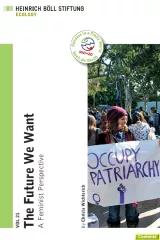
The Future We Want - A Feminist Perspective

The multiple crisis – the financial crash, hunger, climate change and resource scarcity – shows emphatically that neoliberal market globalization cannot fulfill its promises, namely to bring about the ideal allocation of worldwide resources and thus be a win-win game for all. This is also the reason why the growth-based concept of sustainability put forward at the 1992 United Nations Conference on Environment and Development (UNCED) in Rio de Janeiro was doomed to fail, as it constituted an attempt to reconcile economic growth, protection of resources, and social justice. In an effort to salvage the concept of sustainability, which has lost credibility, the United Nations have proposed a Global Green New Deal based on a Green Economy as the new guiding principle for the Rio+20 Conference.
The Green Economy seeks a way out of the financial, climate, and energy crisis and, at the same time, tries to make the connection to the Millennium Development Goals and poverty alleviation. Taking a closer look from a feminist perspective at the papers on the Green Economy, one is struck by the fact how few gender aspects they contain. Twenty years after the Rio Conference they seem to be gender-blind. In 1992, the Agenda 21, the Rio Conference’s final document, recognized women as key actors for environmental protection and poverty alleviation and granted them rights to shape development and environmental policy and make decisions in that area. On this basis, a broad consensus on gender policy came about in the 1990s, namely that ecology and sustainability are not gender neutral, the analysis of gender relations is vital for understanding the relationship between nature and society as well as for resource management and for overcoming environmental crises, without gender justice, there will be no environmental justice, no sustainability, and no good life for all.
Two decades on, the Green Economy papers of the United Nations Environment Programme1 (UNEP) lag behind the Agenda 21. Neither do their various topics reflect gender mainstreaming nor is there an effort to take a feminist perspective into consideration. Climate change has been at the top of the global environmental agenda for years and was, for a long time, treated as if it were a gender-neutral issue. If, in a sustained effort, international gender networks had not tenaciously introduced a gender perspective, the 1992 United Nations Framework Convention on Climate Change (UNFCCC) would still be gender-blind.
In 2008, and only after 14 rounds of negotiations, did the UNFCCC secretariat call on the parties to implement gender-sensitive measures. However, when UN Secretary-General Ban Ki-Moon assembled an advisory group on Climate Change Financing in 2010, he appointed 19 men. Following vehement protests, the high-level body was expanded to include then French finance minister Christine Lagarde. Germany has not taken up the gender message of the 1992 Agenda 21 either. When, in 2011, German political parties nominated 17 experts to the study group “Growth, Prosperity, Quality of Life,” there was not a single woman among them. These examples show that the glass ceiling is still very much in effect in the decision-making arenas of development and environment policy and that women’s expertise is largely being ignored, even though mainstreaming and participation are professed time and again.