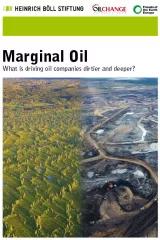
Extreme Oil

Oil Slick, Foto: arbyreed, Quelle: flickr.com, Lizenz: CC BY-NC 2.0
With conventional oil production in decline, the global oil industry is investing heavily in dirtier and riskier forms of oil such as heavy crude, and also in unconventional resources, such as tar sands, and oil shale. All are difficult and costly to produce - and usually more carbon intensive than conventional oil. These resources are often found in “frontier” locations – in or nearby pristine environments as yet untouched by extraction. Current projects include exploration for bitumen-type resources in Venezuela, Madagascar and the Caribbean, and heavy oil in the remote Western Amazon.

Such extreme oil extraction has potentially devastating implications: for global and local efforts to curtail carbon emissions by transitioning away from a fossil fuel-based energy model in emerging and developed economies; for the energy security of importing countries; and ultimately for sustainable growth in producer countries. In addition, many of the new technologies developed to extract the most inaccessible forms of oil are untested, dangerous and may have calamitous long-term impacts on the local environment. As a result, these investments pose a major challenge to the welfare of local communities.

While the companies and governments have promised substantial benefits to the local population, our on-the- ground investigations have revealed significant environmental impacts – threatening pristine rainforest and wildlife, as well as impacting on the livelihoods of local people. Similar impacts are found in the other “frontier” areas. As a result, both the local populations and civil society are beginning to challenge drilling as a viable strategy for development which will help them to achieve the Millennium Development Goals – and in particular to access clean water, education, health – and, of course, energy.  more information »

Venezuela

Abstract

Venezuela - The Orinoco Belt

October 10, 2012 - Venezuela already overtook Saudia Arabia as the country with the largest oil reserves in the world and 2012 is likely to be a crucial year for the climate, as the country aims to ramp up production of huge reserves of tar sands-like crude in the eastern Orinoco River Belt. But economical exploitation comes with huge environmental concerns. Sarah Wykes more»

Republic of Congo

Republic of Congo

October 10, 2012 - The huge 1,790 km square tar sands concession includes savannah, tropical rainforest and wetlands that are home to endangered bird species.The history of oil production in the Republic of Congo does not provide an encouraging scenario for future tar sands extraction. Testimonies by communities impacted by oil report intimidation by both the government and the oil companies.
Christopher Walker more»

Video: Tar Sands - Republic of Congo

Madagascar

Madagascar

October 10, 2012 - Madagascar is increasingly a target for extractives exploration and extraction.  Despite its unique eco-systems – the island is a biodiversity hotspot – extractive industries are regarded as one of the strategic pillars of the country’s future development.  Christopher Walker more»

Video: Tar Sands - Madagascar

Trinidad and Tobago

Trinidad and Tobago

October 10, 2012 - In 2009 Trinidad and Tobago awarded a license to Petroleum Co. of Trinidad and Tobago Ltd. to explore tar sands at Parrylands-Guapo fields, which are thought to contain 2 billion barrels of oil. An Institute of Energy and Mining has recently been established that will "cater for the specific needs of what, in effect, will be an entirely new part of the local oil industry". Christopher Walker more»

Publications

BRIEFING PAPER

Locking up the Future - Unconventional Oil in Africa

November 21, 2011 - What price our future energy?
This short briefing gives an overview of three investments in unconventional oil in Africa currently in prospect in the context of debates about the need to mitigate global environmental threats and ensure sustainable development. more»

STUDY

Eni´s Investment in Tar Sands and Palm Oil in the Congo Basin

- 9. November 2009 - Eni, formerly the Italian state oil company,  is undertaking a new multi-billion dollar investment in Congo in developing tar sands, oil palm for food and bio-diesel and gas-fuelled electricity. Such investments have been heavily criticized for causing social and environmental damage, both locally and globally. The actual study gives background information about the plans. mehr»
Your basket


Terms of delivery
General Terms and Conditions, Heinrich Böll Foundation (hbf)

Following is information concerning your orders: postage and cost, data security policy, exemption clauses, and where to call for further information. more»
Help
A Step-by-step Guide on How to Place an Order on boell.de
A step-by-step guide, explaining in detail how to order publications on boell.de. more»
Video: The German Energiewende
Energytransition.de DOHA Banner eng Banner Focus on Hungary Discover the Böll Stiftung
Blogs
loader
The Foundation in Social Networks
Icon Facebook, CC-BY-SA jwloh01 at gmail dot com Facebook Icon Twitter, CC-BY-SA jwloh01 at gmail dot com Twitter
Icon YouTube, CC-BY-SA jwloh01 at gmail dot com YouTube Icon Flickr, CC-BY-SA jwloh01 at gmail dot com Flickr
Icon SoundCloud SoundCloud Icon RSS-Feed Feeds
Blog Euro Crisis Banner: Triple Crisis Blog Women's Voices, Women's Choices - 100 years of international Women’s Day The Climate Network-Transatlantic Solutions for a Low Carbon Economy