
Essay
Humour has a long history as a means of deflecting responsibility and potential persecution for political criticism. In Gen Z protests in the Balkans, humour has had a special role in conveying public discontent. Recent Gen-Z-led protests in Albania demanding improvements to university conditions and fees utilised ironic memes to get their message across and instigate change.

Foolery, sir, does walk about the orb like the sun; it shines everywhere.
William Shakespeare, Twelfth Night, Act 3, Scene 1
We have all seen how an appropriate and well-timed joke can sometimes influence even grim tyrants . . . The most violent tyrants put up with their clowns and fools, though these often made them the butt of open insults.
Desiderius Erasmus, Praise of Folly
Introduction
Humour has long functioned as a subtle indicator of political fragility. From medieval court jesters to today’s meme culture, laughter has served as a way to safeguard truth, speak openly, and resist authority when direct confrontation becomes dangerous. In societies shaped by historical trauma and political instability, irony often acts a cultural survival strategy. In the Balkans, humour has frequently provided a language through which frustration, criticism, and dissent can be expressed without direct confrontation. This article explores how Generation Z has adapted this tradition, using memes, sarcasm, and social media as tools of protest. Often dismissed as unserious or trivial, these forms of expression reveal how humour can question authority and reshape political culture in clever ways.
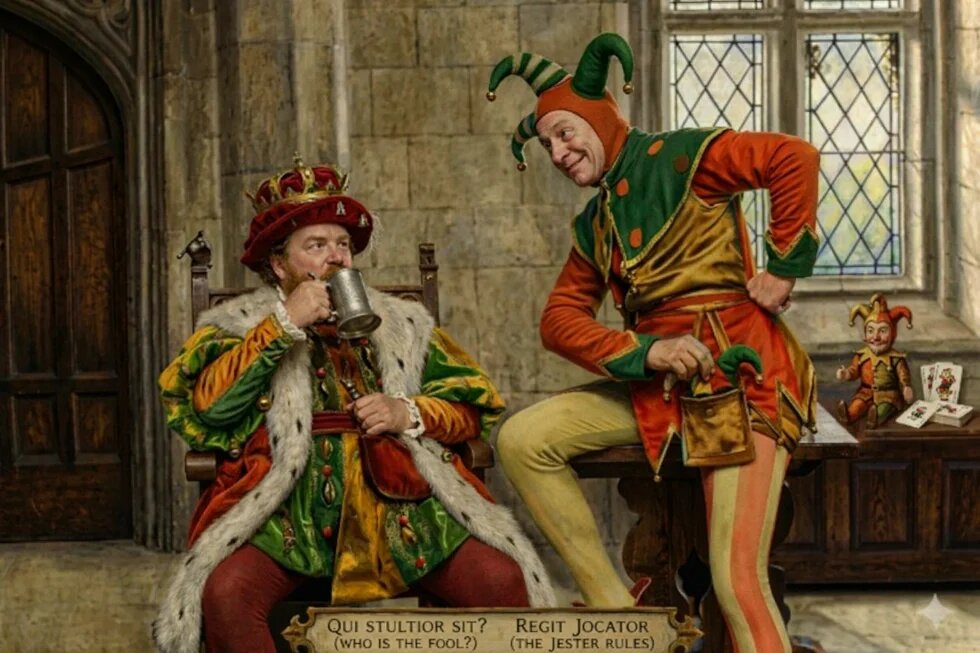
Power has always been afraid of direct confrontation, but it has often put up with being made fun of. The court jester, dressed in bells and motley, had an odd place within the power structure: they were on the outside yet safe, silly but sharp, and defenceless but powerful. The jester's privilege allowed people to speak things that were true while making them comical. Criticisms were eased by laughter, and opposition was hidden as amusement. Even when sovereigns crumbled, and courts passed from sight, the jester persisted, albeit in a changed form.
In the age of the internet, the jester lives again through Generation Z, which is characterised by heightened sarcasm, humour, expanded freedom of expression, and collective fury, especially in places suffering from anguish, torment, grief, and hardships, like the Balkans. In this sense, memes, irony, and cynicism serve not as indicators of political passivity but as adaptive instruments for protest, survival, and transformation.
To make sense of the motivations behind Gen Z's demonstrations in the Balkans, one must consider the historical background these young people have inherited. Centuries of imperial rule, violent border changes, extreme ideologies, tyranny, conflict, and economic instability have all acted as a cumulative force shaping the region. Empires have come and gone within the same territories; identities have been politicised, obliterated, and brought back to life; and truth itself has been broken and turned into something dangerous. In these situations, standing up to power directly has often had terrible consequences. Speaking too openly could result in being exiled, imprisoned, or killed. Humour, on the other hand, offers protection. Irony turns into armour. Laughter becomes a way to stay alive.
This historical dependence on humour as a coping strategy is intentional. In civilisations that have endured great pain, cynicism is often mistaken for apathy when it is in fact an emotional response to repeated disappointment. Balkan humour has long been dark, self-aware, and cutting, capable of mocking both authority and society itself. A well-known example appears in Bosnian wartime humour, where characters like Mujo and Suljo – recurring figures in traditional jokes across the former Yugoslavia, widely shared in oral and popular culture – featured in stories told even during the Siege of Sarajevo (1992–1996). One such joke describes Mujo and Suljo being hit by a grenade while crossing the street; Suljo loses an ear and returns to look for it, only for Mujo to shout that it is not worth it. Suljo replies that it is not about the ear, but about the cigarette he had tucked behind it. The humour is shocking but revealing: even in moments of extreme danger, irony becomes a way of reclaiming agency over fear. It is humour made not with ease, but with resilience. Generation Z takes this cultural impulse and adapts it to a new arena: social media.
From Court Jesters to Digital Fools
The medieval jester pinned their hopes on figurative immunity. Their costume, exaggerated persona, and assumed foolishness protected them. ‘I am only joking’ was not a denial of truth but a strategic shield. Today, memes perform a similar function. A meme compresses critique into humour, emotion into image, and dissent into a shareable form. It spreads quickly, avoids formal language, and resists easy censorship. When a meme is dismissed as ‘just a joke’, this mirrors the jester’s historic defence: the truth is spoken while responsibility is deflected.
Generation Z, the first generation to grow up completely online, knows this instinctively. Generation Z does not treat social media as simply another component of formal politics. Instead, it is perceived as a distinct and often more accessible arena for political engagement. Social media is the main public square, where queens are beheaded, monarchies are burnt, witches are hung, and people yell and cry, sometimes out of ignorance, sometimes out of anger, and sometimes out of self-righteousness. Yet young people continue to challenge authority through these platforms, responding to political narratives with criticism, satire, and mobilisation. Many young people in the Balkans distrust traditional institutions such as unions, political parties, or mainstream media; people in the Balkans have little trust in formal political procedures as corruption, clientelism, and unfulfilled promises are commonplace. Social media is a unique platform because it is decentralised, participatory, and emotionally powerful.
Memes, in this context, are not distractions from politics – they are political speech. They ridicule authority, expose hypocrisy, and circulate shared frustration faster than any manifesto could. They allow young people to participate without asking permission, to protest without leaders, and to remain fluid rather than fixed. This leaderless structure is often criticised as disorganised or chaotic, yet it also makes movements harder to suppress. Power struggles against hierarchy; it struggles even more against collective visibility.
Why Trauma Learns to Laugh
Recent student-led protests across the Balkans illustrate this dynamic clearly.
In November 2024, students in Serbia became a driving force behind rallies following a deadly infrastructure collapse widely attributed to corruption and carelessness. The protests were marked not only by marches and blockades but also by powerful symbolic acts – moments of silence, visual metaphors, and extensive online mobilisation. Social media both announced the protests and framed their emotional tone and narrative. Memes circulated side by side with footage of demonstrations, transforming outrage into a shared language and sustaining momentum even when institutional responses were scornful or aggressive.
In Bulgaria, youth participation was similarly significant during the anti-corruption protests of 2020–2021. The demonstrations, which targeted the government of Prime Minister Boyko Borisov, contributed to Borisov’s resignation in 2021. Here, online spaces functioned as both archive and amplifier. Young protesters documented events in real time, framed political demands through accessible visual language, and used humour to erode official narratives. The combination of determination and irony confused critics, who expected protests to be solemn, hierarchical, and ideologically rigid. Instead, Gen Z expressed dissent in a language that reflected their political reality: fast, emotional, visually literate, and deeply sceptical.
Demonstrations by Albanian students in 2018 and 2019 did not start with grand ideological assertions or language that was rebellious. The administration’s decision to raise the cost of retaking examinations appeared at first to be a minor administrative change. For many students, however, the increase significantly increased the financial burden of continuing their studies. What initially seemed like a technical adjustment soon revealed a deeper problem: access to higher education in Albania was becoming increasingly conditional, unequal, and disconnected from the realities young people faced.
Albania 2018–2019: Laughing at a System that Failed Its Students
Students at the University of Tirana were among the first to mobilise. Protests began in December 2018 as spontaneous, largely uncoordinated gatherings. This lack of formal organisation was not a weakness but a reflection of generational instinct. Students did not trust political parties, student unions, or institutional intermediaries. They trusted one another, and they trusted social media.
As the protests grew, so did their symbolic clarity. Demands quickly expanded beyond axing the exam fee increase to include broader issues: tuition costs, the privatisation of public universities, deteriorating dormitory conditions, lack of transparency, and the commercialisation of education. The protests were explicitly impartial, with students repeatedly refusing attempts by political actors to co-opt the movement. This refusal was itself political. It showed a rejection of a system perceived as incapable of genuine reform.
While the streets filled with protesters, social media filled with language. Memes became the most effective communication tool, distilling complex grievances into instantly legible criticisms. One of the most iconic and widely shared memes read, ‘Është më lirë me kamion drejt Anglisë sesa universiteti në Shqipëri’ (‘It is cheaper to go by truck to England than to attend university in Albania’). Brutal in its simplicity, the meme compared two painful realities: the prohibitive cost of education and the desperation driving mass youth emigration.
When Memes Become Political Speech
This meme did more than provoke laughter. It reframed emigration not as an individual failure but as systemic indictment. The state was no longer losing its youth to ambition; it was pushing them out through neglect. In this sense, the meme functioned as a jester’s blade – incisive, undeniable, and protected by humour.
Other memes highlighted the contradiction between political discourse and material conditions. Images of pristine European universities were contrasted with photographs of Albanian dormitories plagued by mould, broken windows, and inadequate heating. Memes featuring ‘Standardet evropiane, realiteti shqiptar’ (‘European standards, Albanian reality’) circulated widely. These memes required no explanation. They relied on collective recognition rather than argument, bypassing institutional language altogether.
Another recurring motif mocked the unchanging oratory of politicians who claimed that education was a ‘priority’. Screenshots of speeches promising investment in youth were paired with images of students protesting in freezing temperatures, holding handwritten signs. One widely circulated meme featured the phrase ‘Rinia është e ardhmja’ (‘The youth are the future’), followed by the sarcastic addition ‘…po jo këtu’ (‘…just not here’). The ellipsis did the work of accusation. The humour was quiet but devastating.
The Strength of Being Underestimated
Memes also played a crucial role in protecting protesters. In a society where overt confrontation can lead to academic, economic, or social repercussions, humour provides symbolic immunity. A meme can be dismissed as satire, exaggeration, or a joke, yet its message travels far more efficiently than any formal complaint. The parallel with the jester’s privilege is unmistakable. Just as the court jester could criticise the king while claiming to be a fool, students could expose systemic injustice from behind a shield of irony.
Critics called the protests disorganised, frivolous, and immature – words that have been used in the past to describe youth movements as well as clowns. However, this perceived lack of seriousness was precisely what kept the campaign going. It was also hard to repress as there was no single leader. The protests were easy to understand because they did not use serious ideological terminology. Humour made it possible for people to stay involved emotionally.
Social media not only recorded the protests – it made them bigger. Even as the protests died down, memes kept circulating, keeping protesters’ memories alive and strengthening their sense of identity. The movement lived on in policy battles as well as in jokes, allusions, and symbols that changed how a whole generation talked about power.
Thousands of students march through the streets of Tirana during the Albanian student protests on 11 December 2018. The demonstrations, initially triggered by increased university fees and additional exam charges, quickly expanded into a broader movement demanding lower tuition costs, improved dormitory conditions, and greater student representation in university governance.
The Jester’s Afterlife
While the Albanian student protests did not dismantle the system they challenged, they achieved something arguably more profound. They redefined political participation for a generation shaped by disappointment. They demonstrated that protest does not always wear the face of seriousness and that laughter – when sharpened by experience – can be a form of resistance.
Similar dynamics have appeared across the Balkans. In Serbia, student-led demonstrations following the 2024 Novi Sad infrastructure collapse combined symbolic protest with a powerful online culture of satire and memes. In Bulgaria, the anti-corruption protests of 2020–2021 likewise revealed how young people used digital humour and visual language to challenge authority and sustain collective mobilisation.
The jester has survived because the jester adapts. This generation does the same. In a world that often dismisses them as frivolous, Zoomers in the Balkans have shown that humour can be revolutionary, that irony can be ethical, and that laughter can coexist with rage. History does not always change through solemn declarations or formal authority; sometimes, it changes through a joke piercing enough to reveal the truth underneath.
The bells may be digital now, the court replaced by platforms, the costume by irony, but the role remains. The jester did not die. Once again, humour has helped shape the course of history.
The opinions expressed in this article are those of the authors and do not necessarily reflect the views of the Heinrich-Böll-Stiftung e.V.
This contribution is part of our dossier
Gen Z: Voices of a Global Generation
The dossier examines youth-led movements and collectives, their strategies and their visions for a just future. It also explores the roots of their discontent and its expression in digital spaces and the arts by bringing together young voices and perspectives from across the globe. The publication presents the diversity of youth-led movements in various formats.