
Report
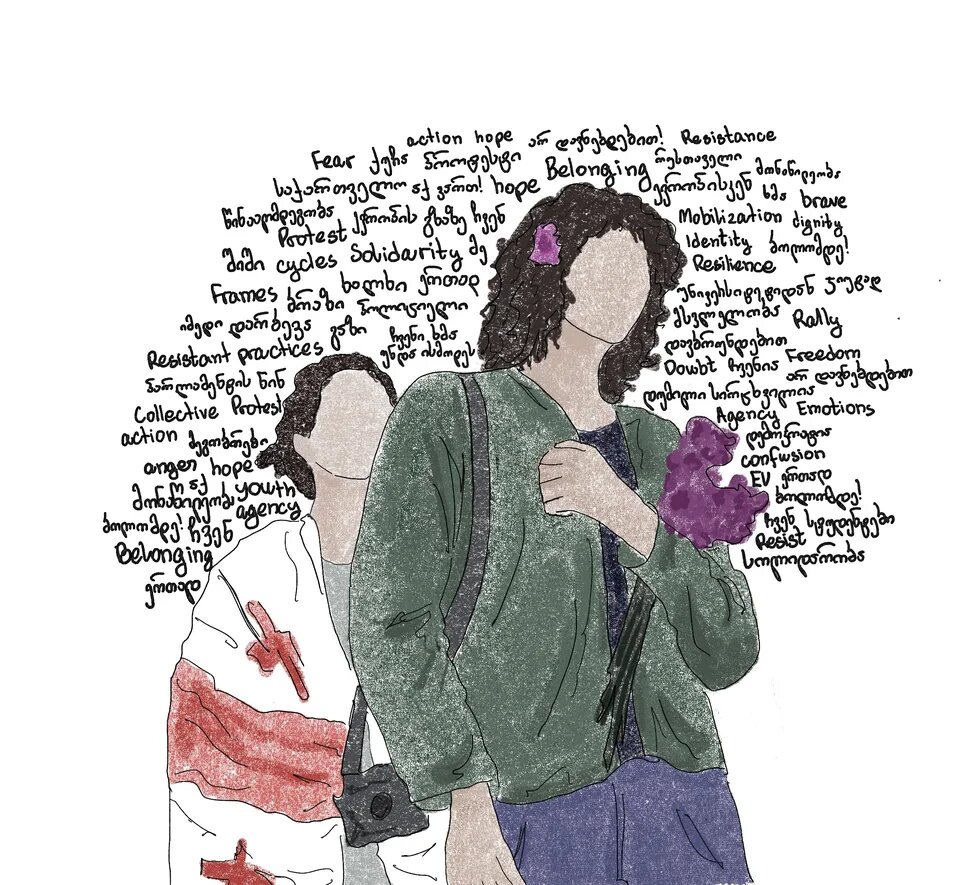
Georgian politics were rocked by sustained protests led by Gen Z from 2023 and 2024. Diaries kept by young people reveal the complex emotional arc many experienced as the protests unfolded, moulded by fear, anger, pride, and hope but also by disappointment and confusion. A shared sense of identity and history served to consolidate protesters’ voices and visions, with values associated with the European Union, including democracy and human rights, providing a frame of reference for protesters’ demands.

It is spring 2023. A water cannon advances toward the parliament building, where crowds have gathered to protest the proposed ‘Law on Transparency of Foreign Influence’ (widely referred to as the ‘Foreign Agents’ bill) – a law widely perceived as an attempt to weaken civil society. Riot police flank the vehicle as it moves forward. Some protesters step back; others remain still. The cannon turns toward the crowd and releases a powerful jet of water.
At the front of the scene, the camera lingers on a young girl, in red sports joggers and a blue bandana, a Georgian flag raised in both hands, moving into the stream. She jumps repeatedly over the rushing water. Riot police bang batons against shields in sharp, metallic rhythms. The cannon continues to roar. The girl keeps jumping, light and unyielding, avoiding the water directed at her. Three days later, the proposed law was withdrawn, yet this image of the girl leaping over the water cannon and of youth in bright clothes dancing atop police sirens moments before a raid endured and circulated widely. These scenes came to define how the protests of 2023 were seen and felt, placing youth at the centre not only of the images but of the political moment itself.
Headlines such as Gen Z: A New Hope?, Gen Z Georgians Push Back against the ‘Foreign Agents’ Law, and How Did Gen Z Earn the Right to Forceful Public Protest? proliferated across Georgian and international media. Since then, the involvement of Gen Z in political processes and protests has become a central topic in Georgian public discourse and online debates. Attention on the youth grew stronger a year later due to the reinstatement of the aforementioned bill in spring 2024 and the pro-EU, anti-government protests that took over the streets of central Tbilisi.
This article examines how youth operate through affective and situational forms rather than through structured advocacy. Their practices, thematic marches, performative gatherings, and collective expressions of emotion constitute a mode of civic participation that emerges where institutional dialogue with the state is limited. The analysis highlights that those emotional experiences, especially fear, anger, pride, and solidarity, serve not merely as background sentiment but as a key mechanism sustaining collective action. The involved youth construct their own subjectivity rooted in affective solidarity and shared historical memory, through which their political agency is reaffirmed beyond institutional forms of political participation, which seem to be particularly unpopular across Gen Z.
To shed light on these dynamics, we draw on 25 ethnographic diaries by young people involved in the autumn 2024 protests. These diaries encompass their reflections and emotions over the course of the protests, resulting in open-ended but systematic and detailed documentation of their individual experiences. Such empirical evidence attests to increasingly visible youth involvement alongside less spectacular yet equally significant performative and symbolic practices.
Emotional Engagement
The emotional landscape unfolding around the protests was marked by intensities that not merely accompanied political action but generated its momentum. Fear, anger, pride, hope, and disappointment functioned as structuring forces shaping how young people inhabited public space, interpreted risk, and constructed their own agency. These emotions emerged through exposure to threats, mutual protection, and the symbolic charge of the protest practices.
Fear manifested as a visceral reaction among youth to the proximity of violence and the unpredictability of the environment. It was often experienced after the crowd dispersed, when the adrenaline of collective presence dissipated. Participant diaries describe these lingering vulnerabilities and bodily fears:
‘I was alone, cold, completely soaked … I was afraid one of those “robocops” would follow me home. Even after locking the door, I still felt I wasn’t alone.’ (Diary #1)
‘The police shouting and batons awaken a deep fear in me.’ (Diary #2)
‘I worry about the people who stay at the protest … anxiety and panic attacks hold me back.’ (Diary #3)
Fear seems to have sharpened awareness of what was at stake. It signalled a heightened awareness of the fragile boundary between personal safety and political responsibility. The diaries repeatedly invoke fear in the future tense: fear of a country in which knowledge is devalued, or where society ‘adapts to every immorality’ (Diary #21). This forward-looking anxiety situated emotions within a temporal horizon: the threat is not only physical but cultural and, by extent, civilisational. In this regard, instead of fear becoming an obstacle that demobilises the protests, fear became an emotion through which the youth morally reassessed what they thought they were fighting for.
Another emotional involvement is manifested as anger, which functions as a counterforce. It accumulates around particular thresholds, producing moral clarity when institutional decisions or violent episodes are perceived as irreversibly unjust. In these moments, anger becomes the emotional architecture of refusal to conform or withstand.
‘For me, November 28 is the day when the line was erased, the last thread snapped, and all the accumulated anger erupted in people – everything [all forms of injustice] became clear, even to those who hadn’t seen or couldn’t see it before. There was nothing left to lose, and the fight for the future became inevitable.’ (Diary #8)
‘We had just received EU candidate status, and suddenly it felt as if everything was thrown away. It caused a big shock and urge to go out in the streets.’ (Diary #14)
Anger condenses frustrations into a clear orientation and transforms participation into a moral imperative. It also restructures the sense of possibility: when the threshold has been crossed, hesitation loses its relevance for the emotionally involved youth.
Pride, by contrast, seems to have emerged as a slower, stabilising mood that sustains participation over time. It is rarely triumphant; instead, it is entangled with fatigue and recognition of sacrifice. It reflects an awareness that one’s presence in the street is part of a wider historical trajectory. The imagery of going back to the protest site, ‘to the place where the tear gas was still felt’ (Diary #1) conveys the dignity attributed to courage under duress.
‘I feel pride. I don’t think any other country ever has had protests of such scale, duration, and unity, without any single leader.’ (Diary #16)
Hope circulates through micro-practices of solidarity rather than expectations of institutional response:
‘The look in that grandmother’s eyes and the crowd’s applause played a huge role in motivating me.’ (Diary #2)
‘My classmates and course mates made me feel protected; I was proud that my friends stood with me without needing an explanation for why they should stand beside me.’ (Diary #7)
These interactions create affective counterweights to exhaustion. Hope therefore appears not as naïve optimism but as a socially produced resource, representing a collective capacity to reorient oneself after disappointment.
At the same time, disappointment and confusion also form part of the emotional cycle. Descriptions of ‘helplessness’, the sense that the system was ‘strong and deeply rooted’ (Diary #6), or evenings when strength was depleted reveal the affective costs of sustained protest. Confusion often emerged during periods of political ambiguity, when the direction of the movement seemed uncertain or when unexpected escalations disrupted established expectations.
‘I am as confused as most protesters. What kind of continuation should this protest have so that the ending is a good one?’ (Diary #5)
‘On the night of 29 December, I was so confused … The protest only intensified that feeling.’ (Diary #13)
These emotions interacted with rather than replaced one another. Fear coexisted with determination; anger opened space for pride; hope repeatedly resurfaced despite fatigue. Emotional engagement became a mode of political reasoning through which young people assessed threats, formed commitments, and made sense of collective action.
Identity and Belonging
The emergence of a collective political subject within the protests is inseparable from processes of identity formation that unfold through affective ties, symbolic markers, and shared vulnerabilities. Belonging is produced not through abstract declarations but through the practical and emotional labour of protecting each other and recognising common stakes.
In a highly fragmented society like Georgia, marked by political polarisation and generational divides, protest spaces become sites of unexpected unity. Solidarity is central to this process. It takes the form of immediate reciprocity – pulling someone up from the ground, offering support under tear gas, or guiding disoriented peers through the crowd. These gestures encapsulate a form of civic intimacy that exceeds friendship or kinship. During the 2024 protests, such interactions created a sense of embodied interdependence and consolidated the perception of a shared feeling of ‘we’.
‘I fell and got lost in the crowd, helpless and terrified, until my friend … grabbed my hand, pulled me up, led me to safety, and ran back to help others. We are fighting together; it is deeper than friendship or being classmates.’ (Diary #1)
‘We stood together and saw the same thing in each other’s eyes – we are one.’ (Diary #3)
On top of shared identity among young people, regional affiliations – whether Kakhian, Imeretian, or Adjarian – provided another dimension. These ties invoked historical narratives of resistance and embedded the contemporary protests within a longer genealogy of opposition to domination.
A broader civic identity emerges when participation is framed as part of a formative national moment:
‘We are in a transitional period in which a united Georgian nation is being formed.’ (Diary #22)
‘This is not Georgia’s awakening or rebirth, but the birth of an entirely new society … I am proud to have witnessed its first moments.’ (Diary #19)
A sense of belonging thus turned out to be one of the main sources of motivation to participate. Belonging operated on both micro (friends, classmates) and macro (national or resistance movement identity) levels. The ‘nation’ became a civic project grounded in shared values, mutual aid, and the aspiration towards a common future.
European belonging constitutes another axis. Chants such as ‘Where are we going? We are going to Europe’ articulate a horizon of orientation in which Europe functions as a symbolic framework for rights and civic aspiration. Protest, then, is about affirming who one is in relation to the world – in this case towards Europe – as well as in relation to others within or outside the boundaries of the state. It should, however, be noted that Europe is imagined in different ways across Georgian society, including among youth. While it can only be speculated what young people strive for in their articulation of aspirations regarding Europe in this particular case, institutional integration within the European Union alone does not seem to cover the entire scope of this sentiment.
‘In the eyes of strangers, one goal was apparent – we all want to live in a European Georgia. It is difficult, but not impossible.’ (Diary #13)
These layers – solidarity, regional identification, civic nationhood, and European orientation – formed a multidimensional sense of belonging. Identity was enacted through mutual solidarity, marches, recognition, and persistence. Through these practices, the protests became a generative space where new forms of ‘we’ took shape, sustained by emotional and relational infrastructures that sustained the movement.
Taken together, these affective and relational practices illuminate how youth participation in Georgia, beyond its visible moments of spectacle, maintain their agency. In this sense, youth take part in shaping how community is felt, imagined, and enacted under conditions where institutional avenues of participation remain limited.
Conclusion
This article has demonstrated that young people’s civic agency in Georgia emerged through affective and situational practices that unfolded in moments of confrontation, care, fear, and collective presence. From the image of a young girl playfully avoiding a water cannon to less visible acts of mutual protection and emotional support, youth utilised an agency grounded in embodied presence and shared experience. At the same time, the protests operated as spaces of identity and belonging. Through embodied solidarity and shared vulnerability, youth constructed a collective sense of ‘we’. Civic belonging was thus enacted rather than assumed, emerging through practices of care and mutual support. European belonging, repeatedly invoked in chants and narratives, provided a moral orientation through which resistance was articulated, situating the protests within broader aspirations for dignity, rights, and democratic life.
The opinions expressed in this article are those of the authors and do not necessarily reflect the views of the Heinrich-Böll-Stiftung e.V.
This contribution is part of our dossier
Gen Z: Voices of a Global Generation
The dossier examines youth-led movements and collectives, their strategies and their visions for a just future. It also explores the roots of their discontent and its expression in digital spaces and the arts by bringing together young voices and perspectives from across the globe. The publication presents the diversity of youth-led movements in various formats.