Video transcript
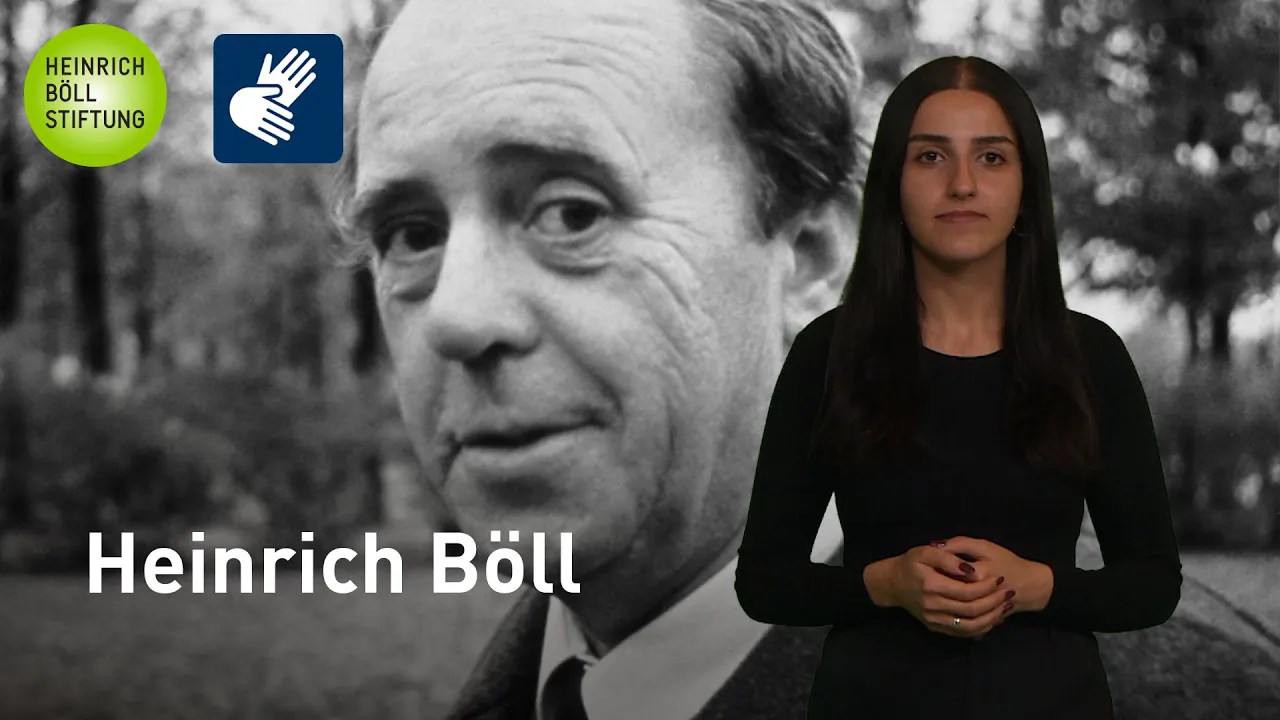
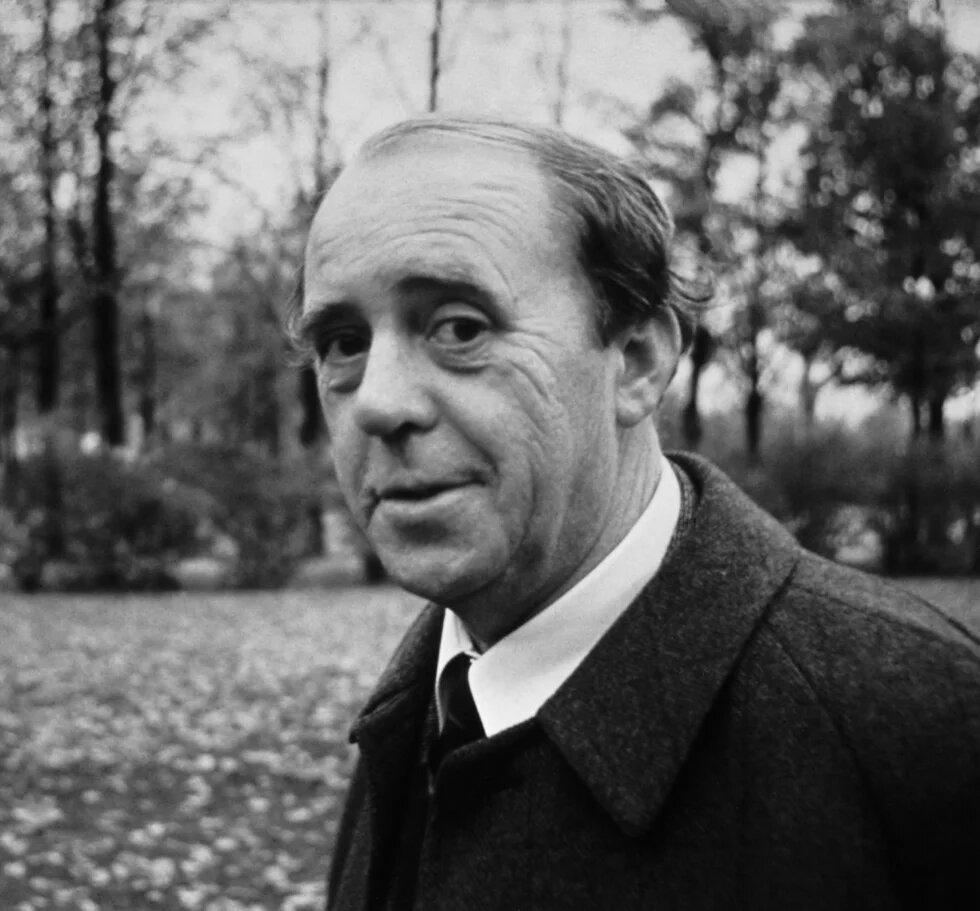
Heinrich Böll is our namesake. He lived from 1917 to 1985. He was a best-selling author, read in schools, and his works have been translated into many languages; some novels have been adapted into films. Böll used his public presence to advocate for democracy and human rights, convinced that "language, love, and connection make us human."
Böll was a public intellectual, a moralist, a Cologne native, a Catholic, a smoker, a humanitarian, and a family man.

Early Years
Heinrich Böll’s early works focused on experiences from the Nazi era, the war, and the immediate post-war period, such as the short stories and narratives “Der Zug war pünktlich” (“The Train Was on Time”) and “Wanderer kommst du nach Spa...” . In 1951, he published his first novel: “Wo warst du, Adam?” (“And where were you, Adam?”). After 1952, Böll turned his attention to contemporary issues in West Germany. In 1959, he published the novel “Billard um halb zehn” (“Billiards at Half Past Nine”), in which he depicted the present of the Federal Republic as a continuation and result of German history from the Kaiserreich to the Bonn Republic. His novel “Ansichten eines Clowns” (“The Clown,” 1963) sparked intense debate.
In 1971, he published “Gruppenbild mit Dame” (“Group Portrait with Lady”), considered his most significant novel. “Die verlorene Ehre der Katharina Blum” (“The Lost Honor of Katharina Blum,” 1974) drew major media attention because, almost unapologetically, it criticized the tabloid newspaper BILD-Zeitung. Five years later, in 1979, he published “Fürsorgliche Belagerung” (“The Safety Net”), and posthumously in 1985, “Frauen vor Flußlandschaft” (“Women in a River Landscape”).
Many labels have been associated with Heinrich Böll. Some contemporaries called him a “moralist,” others deemed him “naive,” and for cynics, he was a “do-gooder.” Some saw him as the spiritual father of the terrorist Red Army Faction (RAF). Catholics considered him too left-wing, while others thought he was too Catholic. Some literary critics mocked his work as “provincial,” while others regarded it as a “chronicle of the Bonn Republic,” and still others praised the diversity of forms in his novels. Some appreciated his “humility,” while others found his public persona lacked the dramatic pathos. Abroad, he was seen as the “other German,” representing the new Federal Republic through his literature; in conservative West German press, however, he was called a „runner-down“ for taking a stand and publicly drawing attention to societal issues. Throughout his life, he resisted these labels and attempts to co-opt his image.
Writer and Political Intellectual
For Heinrich Böll, being a writer and being politically engaged were inseparably connected. The number of appeals, petitions, resolutions, and similar efforts he authored runs into the hundreds. Often, these addressed prominent dissidents or persecuted authors, but they also frequently concerned the fates of unknown women and men. In his speech “Poetry of Action” from 1984, Heinrich Böll pointed out that the Greek root of the word “poetry” has many meanings, and only one of them is about composing and inventing verse. The most important meanings, he explained, “are related to making and doing.”
Böll’s words referred to activist Rupert Neudeck, who, together with Böll, initiated the project “A Ship for Vietnam” to rescue Vietnamese refugees from the South Chinese Sea. In the same speech, Heinrich Böll also appealed to people's empathy, which, in his view, possesses “immense strength, great energy, and creative imagination” that should be opposed to indifference, resignation, cynicism, and apathy.
Heinrich Böll Advocated for Human Rights
Böll stood against oppression in both East and West. He protested against censorship, repression, and persecution in Eastern Europe, Greece, and Portugal during their military dictatorships, as well as in Latin America's dictatorships. This sense of “internationality” was a key reason for his election as president of International PEN in 1971, a position he won—remarkably—with votes from some Eastern Bloc countries.
His work for PEN, especially the “Writers in Prison” project, was one of the highlights of his tenure. He not only advocated for authors but also for their families who faced censorship or persecution in their countries. When publicity could help the persecuted, Böll used his media presence: he gave interviews, wrote open letters and appeals. Many of his activities took place quietly, away from public view.
Heinrich Böll had a critical attitude towards economic growth.
Heinrich Böll expressed his views on issues such as the waste of natural resources—like water, air, and soil—as well as food, such as bread. In almost all of his stories and radio plays from the 1950s, there are ironic references to the appearances of the “economic miracle.” Particularly in his satires, he contrasts contradictions and values in an absurd and exaggerated way.
For example, the “Anecdote Concerning the Lowering of Productivity” describes the (failing) attempt of a tourist in a fishing village to persuade the local fisherman, who is dozing at the harbor, to work more efficiently. “Der Wegwerfer” is a satire from 1957 about free flyers and packaging waste, perhaps more relevant today than ever.
Böll was worried that possession, wealth, and power were becoming ideologically charged values that would soon shape public life; these themes repeatedly drew sharp criticism from him. He distrusted the growth ideology and described society as “a waste society that spends waste as if it were growth.” In interviews, he voiced his displeasure at perceiving himself as part of the “First World” and, in an arrogant manner, referring to other countries as “Third World.”
Heinrich Böll is the namesake of our foundation
Heinrich Böll was very encouraging. "Getting involved is the only way to stay realistic"—this quote from Heinrich Böll also reflects our self-understanding as an ideas and impulses provider.
He supported the newly founded party “Die Grünen” together with his wife Annemarie during the European elections in 1979, as well as in the federal elections in 1983. After Böll’s death in 1985, his family was open to the idea of a “Heinrich Böll Foundation” close to the Green movement.
Heinrich Böll was neither a politician nor a diplomat—he was Heinrich Böll. His stubbornness and independence were his strengths. He was only committed to his own conscience and freedom, and that is exactly what defined his political-moral standing. His work and his engagement are inseparable. Heinrich Böll was an artist and intellectual whose writings are more relevant today than some might think.