
Summary
The majority of respondents want a Europe that is more independent of the US and forges new international partnerships. There is also broad support for a stronger European economy, even if this comes at a higher cost. These are among the findings of this year’s edition of our study on Germany’s role in the EU.

The European Union (EU) faces a number of pressing challenges. It must enhance the competitiveness of its existing industries and invest in the technologies of the future, strengthen its defence capabilities, agree on its long-term budget, forge new partnerships and step up efforts to combat climate change. Germany has a pivotal role to play in addressing these challenges. The Federal Government has declared its ambition to take on a leading role within the EU. But how do German citizens perceive their country’s role in the Union? What do they consider to be the key priorities? This study seeks to foster an empirically grounded debate on the future of Germany’s European policy. Drawing on eight years of survey data, it provides a frame of reference for the strategic direction of that policy, offering context and guidance for its development.
Key Findings of the Representative Survey1
Benefits of EU membership outweigh drawbacks; crises best addressed at EU level: The majority of respondents remain positive about Germany’s membership in the EU. For 63 per cent, the benefits outweigh the drawbacks. Most respondents believe that current crises are more likely to be resolved at EU (54 per cent) than at national level (38 per cent). This preference extends across all surveyed policy areas (only exception: economy, 35 per cent): climate/environmental protection (65 per cent), defence (63 per cent), foreign policy (59 per cent), migration/asylum (57 per cent), digitalisation/AI (52 per cent).
Call for proactive approach; majority supports compromises and pioneer coalitions: 68 per cent of respondents believe that the German Government should play an active role within the EU. Also, 59 per cent support joint decision-making to ensure a strong Europe, even if this requires Germany to make compromises. In addition, 72 per cent favour the option of ‘pioneer coalitions’ when vetoes lead to deadlock.
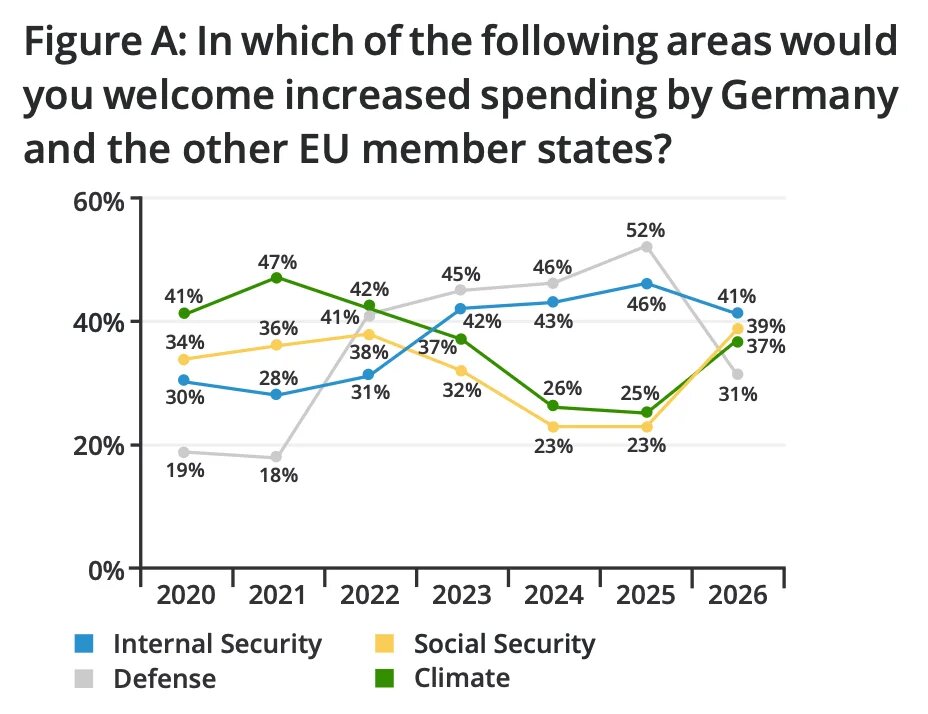
Shifting priorities for additional EU investment: less emphasis on defence, greater support for climate action and social protection: Although respondents remain sceptical about the level of Germany’s contribution to the EU budget, they support increased joint spending in specific policy areas, particularly internal security (41 per cent). Support for additional defence spending has fallen from 52 per cent in 2025 to 31 per cent. By contrast, support for spending on social security has risen from 23 per cent to 39 per cent, and on climate and environmental protection from 25 per cent to 37 per cent.
Majority oppose relaxing climate targets: A combined majority of 62 per cent want the German Government to advocate in Brussels for maintaining the EU’s existing climate targets (36 per cent) or setting even more ambitious targets (26 per cent). By contrast, 33 per cent favour relaxing the EU’s climate targets.
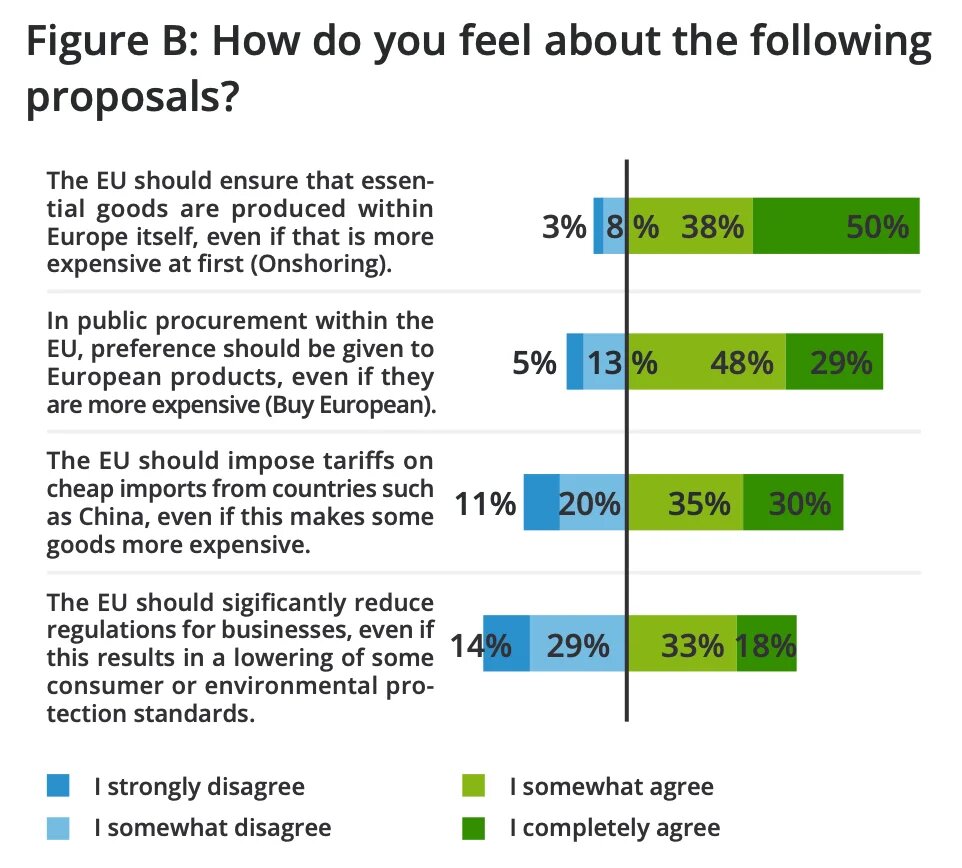
Strong support for measures to strengthen European industry, despite the costs: There is strong support for industrial and trade policy measures aimed at strengthening the European economy and enhancing its resilience. 88 per cent of respondents support onshoring, even if it entails higher costs; 77 per cent back a ‘buy European’ approach; and 65 per cent support tariffs on low-cost imports from China.
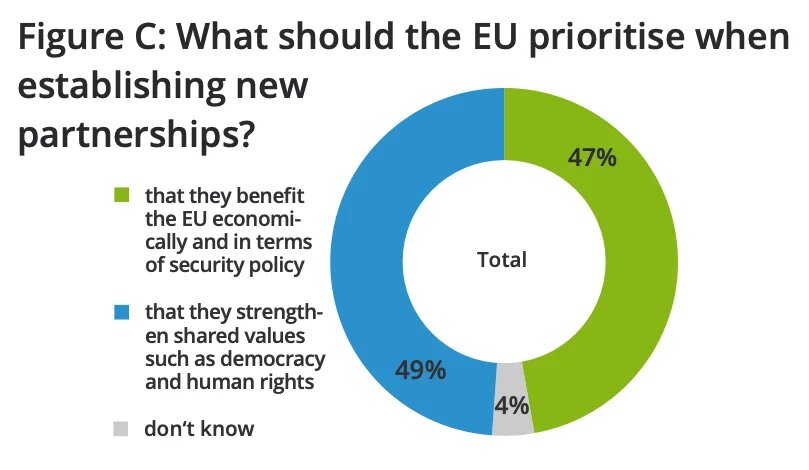
Calls for greater independence from the US; split priorities regarding basis for new partnerships and EU enlargement: According to 76 per cent of respondents, Europe should become more independent of the US and seek new partnerships. 49 per cent believe such partnerships should strengthen joint values (democracy, human rights), while 47 per cent prioritise economic and security interests. Support for EU enlargement is more limited: 40 per cent of respondents are in favour, while 49 per cent oppose it.
Trends and Policy Recommendations
Build European sovereignty through cooperation: The call for European sovereignty is a recurring theme throughout the findings, encompassing the EU’s capacity to act, industrial resilience and independence from the US. Germany’s European policy should seek to build a cooperative European sovereignty, not by pursuing isolationism, but by forging diversified partnerships guided by shared values and interests.
Deepen EU Single Market; strengthen EU industry: The German Government should pursue an EU economic policy that deepens the Single Market by removing internal trade barriers and advancing the Capital Markets Union, while strengthening EU industry through joint investment and industrial policy instruments. This would help demonstrate the EU’s capacity to address economic challenges.
Integrate Europe’s defence industry; avoid excessive costs and monopolies: Rather than focusing on national targets and market share, Germany should pursue a clear European approach to defence, prioritising cost-effectiveness and interoperability while preventing dependencies, monopolies and windfall profits.
Maintain climate ambitions; strengthen EU’s social dimension: A clear majority favour increased joint spending on social protection, climate and environmental protection, and support the EU’s climate targets. Germany’s European policy should therefore strengthen the EU’s social dimension and actively defend its climate targets.
Focus the EU budget on EU added value: Rather than focusing on Germany’s net contribution to the EU budget, the German Government should highlight the benefits of joint investment, explain the need to fund solutions at EU level and ensure that funds are spent efficiently, with a clear focus on EU added value.
The summary of the study is available as a PDF here.
1 For this study, pollytix strategic research GmbH conducted an online survey of 3,023 people on behalf of the Heinrich Böll Foundation between 27 August and 4 September 2026. The results are representative of voting-eligible citizens aged 18 and over. The margin of statistical error for the overall results ranges from ±1.1 to ±1.8 percentage points.