
Analysis
The Legal Amazon is the most dangerous region in Brazil for defenders of human and environmental rights. Agribusiness, illegal mining, and timber exploitation are behind many murders that remain unpunished.

The prevailing imagery of the Amazon consists of lush forests, Indigenous peoples, and an abundance of water. However, one of the most pressing issues that must be included in this narrative and gain global relevance is the violence against environmental and human rights defenders.
Defenders, as we refer to them here, are individuals who advocate for or work toward the realization of environmental and human rights, as well as fundamental freedoms recognized both nationally and internationally. They contribute to improving social, political, and economic conditions, raising awareness about rights, and shaping policies to protect and promote environmental and human rights. And there is a particular group of defenders who frequently faces threats and obstacles due to the causes they champion and the demands they make.
Why the Amazon Is the World’s Most Dangerous Place for Environmental Defenders?
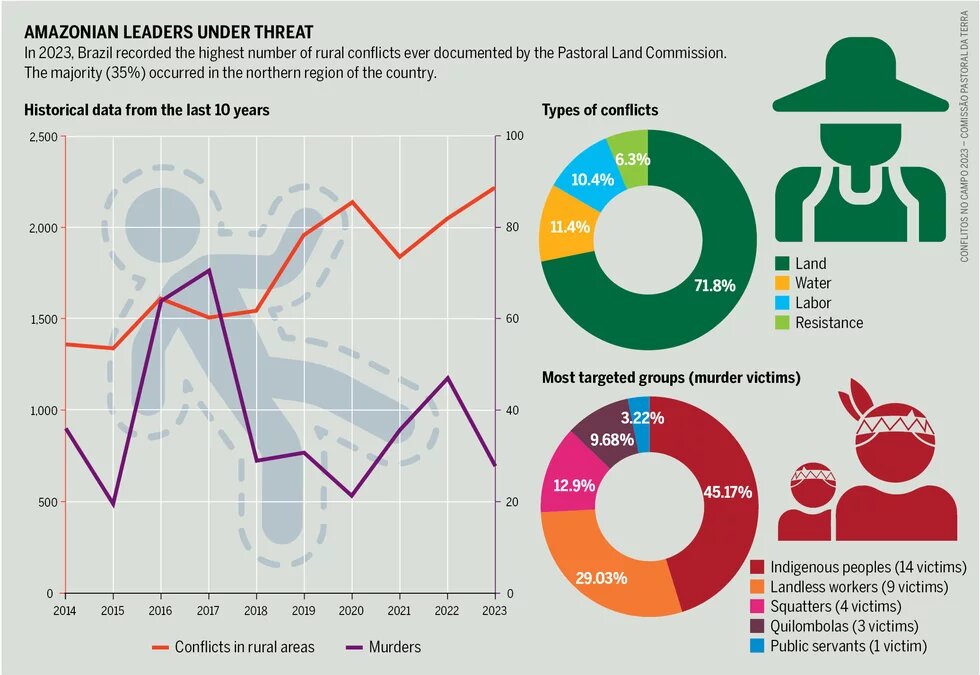
According to Global Witness, between 2012 and 2022, 1,910 male and female defenders lost their lives while protecting the planet. Latin America accounts for 88 percent of these murders worldwide, with Colombia registering the highest number of murders, followed by Brazil. In 2022 alone, 34 defenders were killed in Brazil, more than a third of whom were Indigenous peoples (36 percent), while over a fifth were small farmers (22 percent). The Legal Amazon is the most dangerous region for defenders in Brazil. Data from Global Justice indicates that, over the past four years, four of the five states with the highest number of recorded attacks against defenders are in the Legal Amazon: Rondônia, Maranhão, Pará, and Tocantins. The most prevalent rights violations are linked primarily to land conflicts, followed by labor and water disputes.
Nearly half of these violations involve threats (49.4 percent), followed by physical attacks (16.8 percent) and murders (14.4 percent). Murders represent just the tip of the iceberg, as countless attacks against defenders go unreported.
The Brazilian government has taken steps to mitigate violence against defenders, with the creation of the National Policy for the Protection of Human Rights Defenders, Communicators, and Environmentalists as its main initiative. However, reports from civil society organizations emphasize the need to strengthen the governmental structure responsible for implementing this program, as well as the urgency of ratifying the Escazú Agreement – the first environmental treaty in Latin America and the Caribbean. This agreement not only promotes access to information and public participation, but also establishes specific mechanisms for protecting environmental defenders.
The primary causes of this violence are linked to agribusiness, followed by mining and logging. These three sectors are also significant contributors to global greenhouse gas emissions, underscoring the direct link between the struggle of human and environmental rights defenders and the fight against climate change.
Historical Roots of Violence and Territorial Disputes in the Amazon
Historically, violence in Brazil dates back to Portuguese colonization, but it was during the government of President Getúlio Vargas (1930–1945) that the first efforts to colonize the Amazon were undertaken, motivated by strategic national interests. Getúlio Vargas initiated a continuous cycle of government incentives for forest exploitation. The Brazilian military dictatorship (1964–1985) further deepened this process under the pretext of national security, opening the Amazon to multinational companies from the United States, Japan, Canada, and Norway. This period marked an occupation of the region driven by external forces, enforced through violence and coercion.
The Brazilian agrarian issue remains a central factor. Defined as a set of rural problems intertwined with the country’s broader social structure, it has profound impacts on both rural and urban areas. The consolidation of a powerful agrarian elite, which controls land, wealth, and political influence, has resulted in the expulsion of rural populations. The process of “opening” the Amazon prioritized individual and external economic interests to the detriment of the collective rights of its inhabitants, leading to expropriation, threats, and territorial violations. This facilitated the establishment of a development model built on environmental destruction, land dispossession, and violence against environmental and human rights leaders, with the primary goal of supplying raw materials to foreign markets.
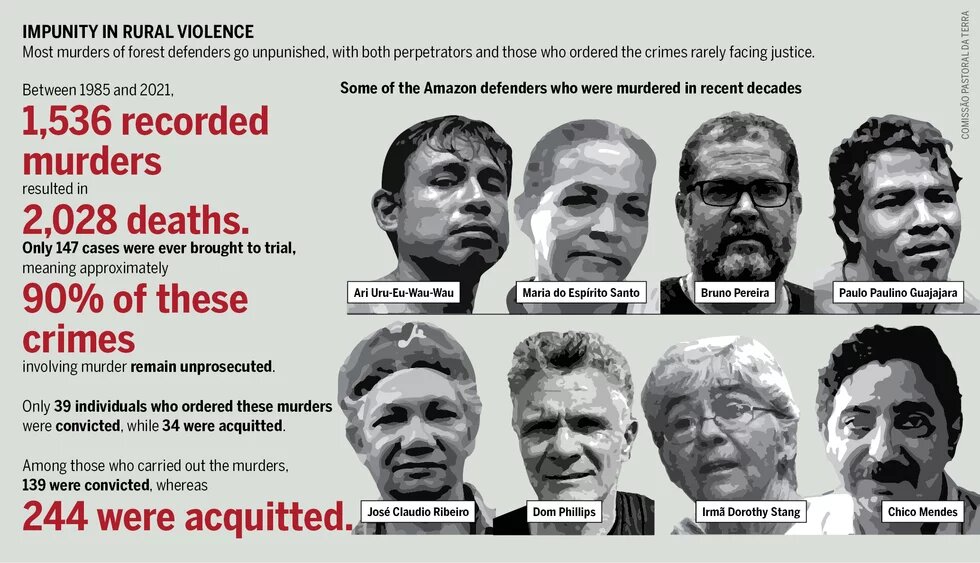
Consequently, prominent defenders of the Amazon have been murdered, including Chico Mendes, José Cláudio Ribeiro, Maria do Espírito Santo, Sister Dorothy Stang, Paulo Paulino Guajajara, and, more recently, Dom Phillips and Bruno Pereira. Many of these crimes remain unresolved within the justice system.
This development model was structured around the construction of roads, waterways, ports, hydroelectric power plants, mining operations, and other extractive projects. These initiatives accelerated the expansion of monoculture farming and livestock farming into Amazonian territories, driving deforestation and fires. This, in turn, led to the loss of forest cover, the displacement of Indigenous and traditional communities, and widespread human rights violations. In this context, violence has become a systemic tool.
The article was first published in the Brazilian Amazon Atlas
See the Portuguese Atlas version here
