
Commentary
Women’s unpaid labor continues to prop up economies while remaining invisible in GDP and absent from budgets. With debt crises and austerity deepening across the continent, Felogene Anumo exposes how fiscal systems rely on women as shock absorbers - and argues it’s time to rewrite the economic rules that keep care undervalued and women overburdened.

In December 2025, two historic milestones converged with symbolic weight. The UN General Assembly adopted a landmark resolution recognizing care work as essential to all other work and calling for increased investment in care infrastructure. Days later, Kenya's Cabinet approved the National Care Policy, becoming the first of Africa's 54 nations to formally adopt a coordinated care framework. Yet these victories expose an uncomfortable truth. Across the continent, women continue performing the invisible labour that sustains entire economies while fiscal systems extract and devalue their work.
Numbers reveal the scale of the crisis. Women perform three-quarters of the world's unpaid care work, spending 4 hours and 25 minutes daily on caregiving compared to men's 1 hour and 23 minutes, keeping an estimated 606 million working-age women out of the formal workforce. Women who do enter paid work are concentrated in the low-wage care sector without adequate protections and wages. Expanding access to quality care services and improving conditions for care workers could simultaneously unlock women's economic participation, create millions of decent jobs and transform economies.
Women Are the (Invisible) Foundation of African Economies
Africa's economic model rests on a foundation of unpaid women’s labor worth up to 40 percent of Gross Domestic Product (GDP) in some African countries. This work remains invisible from national accounts, excluded from budgets, and dismissed as outside of "real" economics. Reflecting both the patriarchal foundations of capitalist systems and the fundamental limitations of GDP itself as a measure of economic well-being.
Nobel laureate Simon Kuznets, considered the father of GDP, famously wrote in 1934 that "the welfare of a nation can scarcely be inferred from a measurement of national income." GDP remains the world's most influential indicator of progress, obscuring rather than enlightening our understanding of a nation’s success. GDP was designed to measure market transactions, not the social reproduction work performed overwhelmingly by women. This has profound consequences: when care is invisible in national accounts, it becomes invisible in budgets; when it is invisible in budgets, women's unpaid labour remains the last unquestioned subsidy to the economy.
When African governments say they cannot afford to invest in care, what they are really saying is they have chosen not to.
As the UN High-Level Expert Group on Beyond GDP observes, “some important non-market activities such as unpaid household care services cannot be captured by GDP”. This, however, is not by accident but the output of years of structural reinforcement. Despite decades of advocacy to transition to alternatives that offer more holistic measures of progress, GDP's institutional entrenchment in policy, legislation, and development finance has blocked economic transformation required to put people and planet first.
New Crisis, Familiar Burdens: Women Serve as Shock Absorbers
Africa’s current debt challenges reflect not only recent shocks but a longer history of externally driven policy choices shaped by unequal power relations in the global financial system. After inheriting commodity-dependent, export-oriented economies from colonialism, many African countries were pushed into structural adjustment programmes and later into new waves of borrowing from a changing mix of creditors, including private and commercial lenders, which prioritized fiscal consolidation and market‑led reforms over public investment.
These dynamics, reinforced by the COVID‑19 crisis, climate crises, geopolitical crises and rigid debt governance frameworks, have constrained governments’ fiscal space and contributed to chronic underinvestment in public services such as education, health, and social protection.
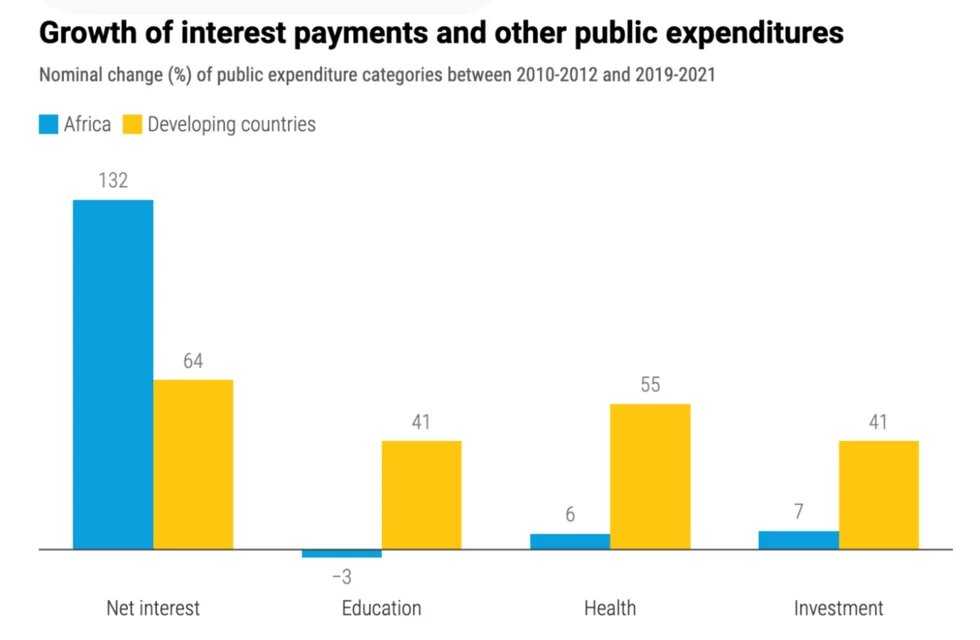
The scale of the debt crisis is now staggering. Between 2010 and 2025, Africa’s debt increased by 183 percent, with the interest payments surging by 132 percent. Approximately 25 African countries face debt distress; roughly 34 countries spend more on external debt than on health and education combined. Today, nearly three-in-five people on the continent live in countries spending more on servicing external debt than on education or healthcare.
When governments cut public services to meet debt obligations, care burdens don't disappear, they shift to households, falling overwhelmingly on women's shoulders. Feminist economists describe this as gendered austerity where women, girls and non-binary people become society's involuntary shock absorbers, providing additional unpaid care work to fill gaps the state abandons.
To compound this further, the fiscal architecture is deliberately regressive. African tax systems rely heavily on consumption taxes like Value-Added Taxes (VAT) with women-headed households bearing the greatest burden. Meanwhile, corporations and wealthy individuals systematically evade taxation. The sum effect is a moral inversion: the poorest subsidizing the richest, where those who care the most are cared for the least.
The sum effect is a moral inversion: the poorest subsidizing the richest, where those who care the most are cared for the least.
It's Time to Rethink the Economic Rules We Live By
Feminist economists have long upheld what mainstream economists ignore: fiscal policy is never gender-neutral. Every budget embodies choices about whose work is valued, whose needs matter, and whose labour can be extracted without compensation. When African governments say they cannot afford to invest in care, what they are really saying is they have chosen not to. That choice has a price; and women have been paying it for decades.
As the UN resolution and Kenya’s National Care Policy affirm, care is a macro-critical foundation of human well-being and sustainable development, not a private family burden or charitable add-on. To honour the women whose unpaid and underpaid labour has long subsidised underfunded public systems, governments must now move beyond symbolic commitments to concrete fiscal and institutional reforms: measuring unpaid care, investing in quality public services and infrastructure, and redesigning tax and spending regimes so they redistribute, rather than intensify, the care load.
Only by centring care in budget decisions, economic planning and social protection can Africa transform these landmark decisions into a new social contract where caregivers’ rights, time and incomes are visible, valued and decisively supported.
