
Commentary
All of Rebecca Harms‘ commitment for Ukraine began with a visit to Tschornobyl in 1988. On the occasion of the 40th anniversary she reflects on the contempt for humanity of the changing regimes in Moscow and the rift between the reactions to the disaster 1986 and the invasion of 2022.

There are days that stay in memory forever. The day I first came to Chornobyl is one of those days for me. In October 1988, I travelled with a delegation of German environmentalists to Moscow at the invitation of the Soviet Writers' Union. In three groups, we continued on to Lake Baikal, to St. Petersburg - still called Leningrad at the time - and to Chornobyl. Together with Stefan Kohler from the Öko-Institut and Kurt Oeser, the environmental officer of the Protestant Church, I travelled to Kyiv and Chornobyl. I had been invited because I was at that time chairwoman of the citizens' initiative of Lüchow-Dannenberg. As a staff member of Undine von Blottnitz, a Green Member of the European Parliament, I had coordinated a report on Chornobyl and the radioactive contamination of soils in the European Community.
We were accompanied by two Ukrainian writers who, a few years later, went on to hold political offices in an independent Ukraine. The filmmaker and writer Volodymyr Yavorivsky served as a member of parliament from 1991 to 2014, with interruptions, first in the Supreme Council of Ukraine and then in the Verkhovna Rada. Yuri Shcherbak, a physician and writer, was a co-founder of the Green Party in Ukraine and the country's first Minister of the Environment, later serving as ambassador to Israel, the United States, and Canada. After the catastrophic accident, both had worked as liquidators in the exclusion zone. The first thing they explained to us was that Chornobyl had changed the way time was written. Previously, they would have said something happened before or after the Great Patriotic War. Now they would say: that was before or after Chornobyl. The nuclear catastrophe had divided time anew.
Chornobyl: Between Memory and Suppression
In 2004, I came to Ukraine for the first time as a Member of the European Parliament. That year, the Central and Eastern European states joined the European Union, and on the streets of Kyiv the "Orange Revolution" was beginning - the Ukrainian people's fight for independence and a path toward the West. Over time, Ukraine became my second political home. I returned to Chornobyl regularly on the major anniversaries. My most recent visit, until now, was at the invitation of Petro Poroshenko, as part of a G7 ambassadors' delegation in 2016, for the 30th anniversary of the reactor accident.
For thirty years, hundreds of thousands of soldiers and workers - first mostly men, later also many women - had cleaned up, had done what needed to be done after the accident and the shutdown of the reactors. They had demolished buildings, paved roads, and poured fresh concrete. Soil had been removed across wide areas and the radioactive earth buried elsewhere. Scrapyards were set up for contaminated helicopters, tanks, and trucks, which reportedly later served as spare parts depots. Animals from the contaminated zone that hunters had to shoot - to prevent their meat from entering circulation - disappeared into mass graves. The construction of the second sarcophagus alone had cost around 1.5 billion US dollars by 2016 and, like the waste disposal facilities, had not yet been completed. At the commemoration ceremony at the Chornobyl power plant in April 2016, Ukrainian President Petro Poroshenko received new cheques from the G7 countries. The ambitious structure, which during the site visit stood like a sign from the future amid the desolate power plant landscape, was for some of the donors proof that the consequences of a nuclear catastrophe can be managed. This was necessary, they argued, because one must assume that catastrophic accidents will happen. Others had closed the chapter on nuclear power after Chornobyl and were investing in their own safety. Meanwhile, in the zone, grass and forest were growing over everything.
The Soviet System at Chornobyl: Contempt for Human Life
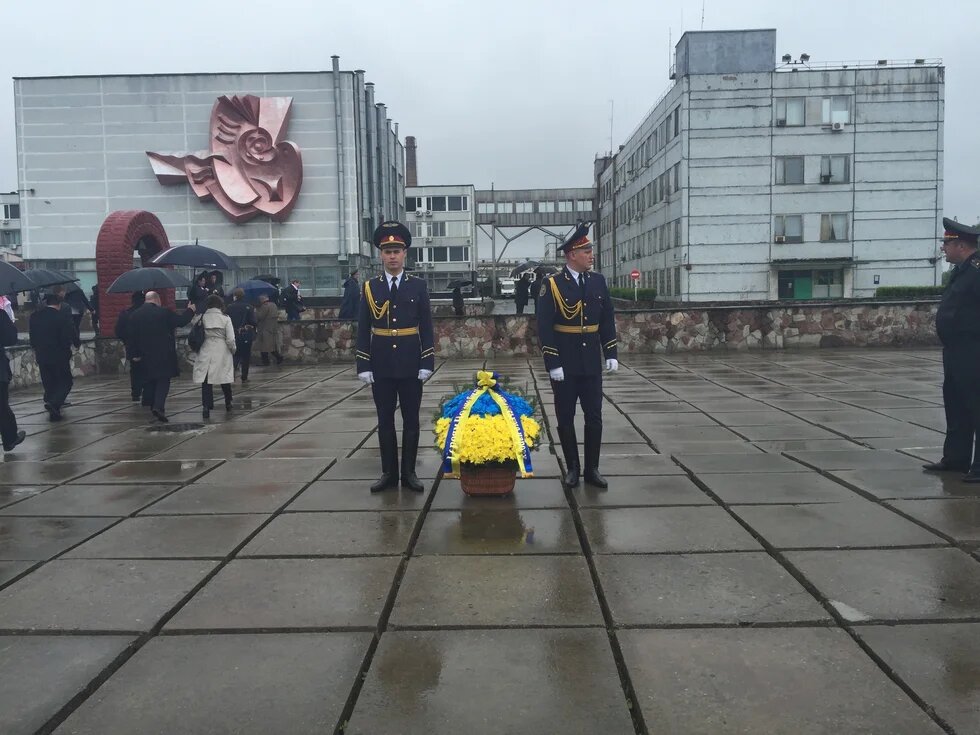
Part of the G7 ambassadors' programme was a ceremonial wreath-laying in honour of the heroes of Chornobyl. The first power plant employee to lose his life in 1986 is commemorated inside the plant with a plaque. For the 30 men who died after him, memorial boards stand opposite the entrance. Hundreds of thousands of firefighters, plant workers, and soldiers - biorobots and liquidators - were sent into the zone after the explosion 40 years ago. They came from all parts of the Soviet Union. Most did not come voluntarily. They were not prepared for the mission, not equipped for it, not informed about the invisible dangers. "Nix Glasnost," one of the experts we met in 1988 told us. When there was not enough water to wash after work, vodka was used to rinse from the inside and the radiophobia was numbed. Just as they had once stood against fascism for the fatherland, they now fought against a new, unknown, and invisible enemy. Entire battalions were thrown into the battle against the fire at Chornobyl, and the fight continued even after Block 4 was buried under the first sarcophagus. Even if rebellions were reported later in some cases, the people of the Soviet Union submitted to the orders from Moscow and the Soviet nuclear state. How many victims, deaths, and illnesses this deployment cost, how many of those who had been sent "on a voluntary business trip" later had sick children or grandchildren - precise figures are scarce.
For the Soviet Union, Chornobyl was another heavy blow that caused the barrel to overflow. What I saw in 1988 was contempt for human beings. What else does it mean when a state demands that its soldiers and citizens work and live unprotected from radiation in an exclusion zone? Mikhail Gorbachev, too - still revered by many in the West to this day - shared in that contempt. He tried to conceal the catastrophic accident. He participated in the systematic, downplaying lies. It was this contempt for people that I witnessed in Chornobyl in 1988, and upon which the Soviet system soon afterwards foundered. Our two guides had already predicted this failure back in 1988.
For the Soviet Union, Chornobyl was another heavy blow that caused the barrel to overflow. What I saw in 1988 was contempt for human beings.
After the catastrophic accident, soldiers had forced the people in the villages around the zone at gunpoint to slaughter their chickens, destroy their eggs, and stop drinking the water from their wells. Yet those same soldiers and other helpers were sent unprotected into a zone in which they had every reason to be afraid of what surrounded them - so the writer and Nobel laureate Svetlana Alexievich told me in a conversation on the occasion of the 30th anniversary of the catastrophe. Evil had become total. But only a few had run from it. Most people had not yet had any conception of freedom, Svetlana said.
2022: The Return of Nuclear Danger in War
The 24th of February 2022 is also a day I will never forget. In anticipation that Russia would launch a new attack on Ukraine, I had arranged with my Kyiv friend Nataliya Gumenyuk to call her at five in the morning. By then, the large-scale attack had already begun. Nataliya reported explosions in Kyiv, told me that Russia was attacking from the north, east, and south, by land and from the air. And while I then tried to help those who had to flee Kyiv and other cities from the bombs, a message arrived from friends in the Verkhovna Rada - one I could never have anticipated. The Russian army had attacked and occupied the exclusion zone and the Chornobyl nuclear power plant from Belarus. The security personnel had been unprepared and had surrendered. The entire operating crew had been taken hostage. The Russian army wanted to use the exclusion zone to secure its advance on Kyiv. Alexievich's words shot through my mind: Evil has become total.
For decades, thousands of soldiers and helpers had performed dangerous work to limit the consequences of Chornobyl. And now Russian soldiers had been ordered to attack what thousands upon thousands of people had rebuilt and achieved in the wake of the nuclear catastrophe. They were even ordered to dig into the contaminated soil. While they stirred up radioactive dust with tanks and shovels, the destruction of the power supply threatened to cause the cooling systems for the spent fuel storage pools to fail. What happened at Chornobyl on 24 February 2022 did not put all of Europe in danger again - but it did endanger the region and the people there. The attack on Chornobyl demonstrated the recklessness and, once again, that contempt for human beings that I had encountered in 1988, and which those in power in the Kremlin have not abandoned to this day - not even toward their own soldiers.
Under the Geneva Convention, nuclear facilities are specially protected even in armed conflict.
From the Rada and from the Ministry of Energy in Kyiv, I was asked to enquire with the German government whether and how it would respond to the attack on Chornobyl. Attacks on nuclear facilities in wartime had not occurred before. Under the Geneva Convention, nuclear facilities are specially protected even in armed conflict. The response from the Ministry of the Environment came after two days. I was told that the situation was being monitored. The risks were low, since no reactor was operating and the fuel elements, after long storage, were no longer hot. A critical situation was not to be expected. The Ukrainians, however, were exaggerating the dangers of the attack. Their aim, I was told, was to draw Germany into the war.
Even before the Russian soldiers withdrew from Chornobyl as well, due to the failure of the advance on Kyiv, the Russian army attacked the Zaporizhzhia nuclear power plant - the largest in Europe. Even demonstrations in Enerhodar, the city of the nuclear power plant employees, when citizens formed a human shield, could not prevent the takeover. The reactors at Zaporizhzhia have since been shut down. But critical situations have continued to occur repeatedly since 2022. The entire surrounding area was mined. Weapons and ammunition were stored on the plant grounds. The destruction of the Kakhovka dam in 2023 impeded the cooling of the reactors and storage pools.
Nuclear Power in Wartime: Ignored Risks and Political Responsibility
What is largely ignored internationally are the consequences of Russian attacks on Ukraine's energy infrastructure. At the three nuclear power plants running at full capacity - Khmelnytskyi, Rivne, and South Ukraine - there have been repeated outages and serious problems. Their reactors have had to be abruptly throttled back on multiple occasions. Each time, this has meant a risk of accident. Unlike the German government, the Ukrainian government has no choice about whether to shut down these reactors. The energy crisis caused by Russia's attacks makes continued high-risk operation necessary despite Russian bombardment. With each new wave of Russian attacks, Ukraine - and Europe - faces the threat of a nuclear catastrophe. The reactors in Ukraine have become, for Russia's attackers, installed atomic bombs.
This ever-smouldering nuclear danger is being widely suppressed in the West and in Germany. More or less everyone bears some responsibility for this. There are, on the one hand, those who believe that a climate-friendly energy supply is only possible with nuclear power. It simply does not fit the nuclear lobby's new advertising campaign to discuss the safety of nuclear facilities in times of war. And even as Russia allows nuclear time bombs to tick in Ukraine, cooperation with the Russian state nuclear corporation Rosatom is to be intensified. Patronised by the International Atomic Energy Association (IAEA), Rosatom continues to work with nuclear corporations that apparently consider it normal that Rosatom was and is directly involved in the nuclear terror at Zaporizhzhia. I have yet to hear anything in Germany about protests against Russian influence in the IAEA.
The reactors in Ukraine have become, for Russia's attackers, installed atomic bombs.
By the way: what about the German anti-nuclear movement? Chornobyl 1986 was the event that made the phase-out of nuclear energy conceivable. The German anti-nuclear movement would not have played such a successful role without the catastrophic accident. The Greens would not have entered parliament so quickly in the 1980s and 1990s. The SPD would not have passed its decision to exit nuclear power. Forty years later, Russia has repeatedly attacked nuclear facilities directly or indirectly bombed operating nuclear power plants to the brink of catastrophe. Where is the loud response to this? Who reads the reports by Greenpeace or Truth Hounds on Zaporizhzhia, the terror against the operating crews, and the risks of the planned restart by Rosatom? To this day, the downplaying of the attack on Chornobyl continues to have an effect in Germany. Far more powerful, however, is the fear of the Russian nuclear bomb. This fear is paired in Germany with a rejection of nuclear deterrence. The underlying belief is that those who do not allow themselves to be drawn into the war or the logic of rearmament will be spared. Meanwhile, the country that is the only one to have given up its nuclear weapons continues to be subjected to war.
Forty years later, Russia has repeatedly attacked nuclear facilities directly or indirectly bombed operating nuclear power plants to the brink of catastrophe.
The 40th anniversary of Chornobyl is approaching. Germans will recall what led us to shut down our nuclear power plants. There will be the ritual debate about whether that was right or wrong. Gorbachev will speak to us from the archives. We will hear his lies and see how the graphite fire blazed in Block 4, how people sacrificed their lives and health to mitigate the consequences of the catastrophe. With solemnity, it will be noted that only in a state like the Soviet Union could so many people have been sent on such a mission. And that we should be grateful to these heroes, because they saved us from a greater catastrophe. This will be said while today we leave it to the Ukrainians to win the war alone. If we truly took the heroes of Chornobyl as seriously as we so often claim, we would be better allies - we would have helped the Ukrainians close the skies over their country long ago, and we would not allow their nuclear power plants to become time bombs. As long as no radioactive cloud drifts over German cities, it apparently suffices to use the 1986 catastrophe as justification for shutting down our own nuclear plants. And behind the German mantra that we must not allow ourselves to be drawn into the war by the Ukrainians, what is growing - absurdly - is not a movement against Russia and its contemptuous conduct of war, but against the capacity for defence and against the West's common nuclear deterrence.


