
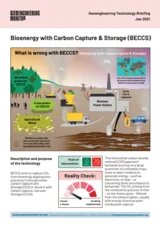

BECCS is a Carbon Dioxide Removal (CDR) technology that aims to capture carbon dioxide from bioenergy applications and then store it in geological formations through Carbon Capture and Storage (CCS) or reuse it through Carbon Capture, Use and Storage (CCUS). It involves burning very large quantities of biofuels and biomass from cultivated crops, trees and plant residues to generate energy, or converting them into ethanol to then be burned. Most BECCS schemes seek to capture the carbon dioxide released during combustion through an energy-intensive post-combustion capture process where carbon dioxide is filtered out of exhaust gasses.
BECCS is referred to as “carbon negative” by its proponents because bioenergy generation is wrongly assumed to be “carbon neutral” and smokestack carbon emissions are therefore ignored, based on the idea that plants will regrow and reabsorb the carbon dioxide that has been emitted. It overlooks emissions from land use change as well as life cycle emissions, such as during cultivation, harvest and transport. It also ignores the carbon debt that results from the fact that, particularly in the case of trees, plants grow much more slowly than they are harvested and burned.
Product details
Table of contents
- Description and purpose of the technology
- Actors involved
- Impacts of the technology
- Reality check
- Further reading
- Endnotes