
Analysis
For rural communities and the farming sector, conserving water and energy is no longer one option among others. It is an essential pillar of adaptation to climate change. Agroecology goes beyond the limits of organic farming by integrating agricultural, environmental, social and economic choices into a unified system.

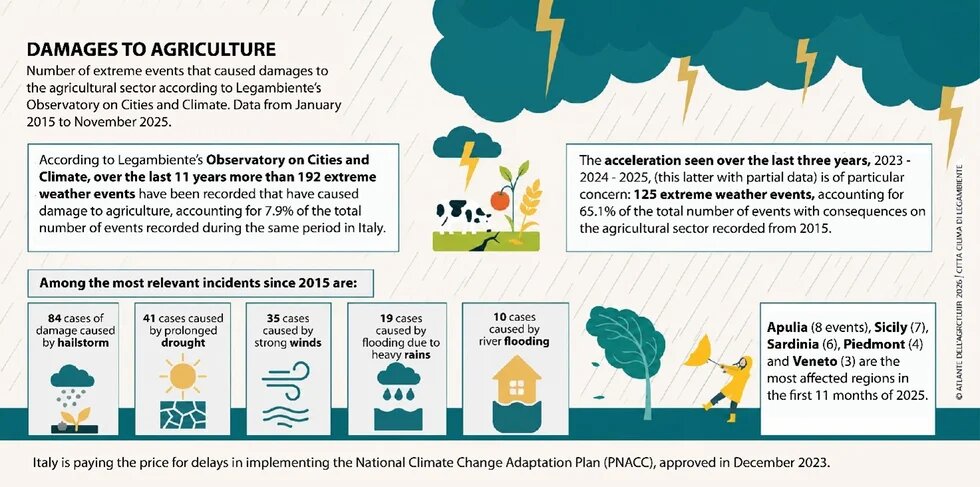
In an era marked by the increasingly obvious effects of the climate crisis, water conservation is no longer about simply conforming to best practices. It is rather about survival and adaptation. Heatwaves, torrential rains and extreme drought are no longer exceptional events; they have become the new normal. From 2010 to 2025, Italy experienced hundreds of floods, river overflows and landslides caused by heavy rainfall. IPCC experts warn that the future will be characterized by increasingly intense swings between drought and violent downpours.1
These are impacts that affect not only ecosystems, but also the economy, agriculture, and quality of life. Crops are shifting, yields are shrinking, animal and plant species are altering their lifecycles. In Sicily, Calabria and Puglia, exotic fruits have now partly replaced the traditional crops, while in Valle d’Aosta the vineyards are climbing the slopes in search of a milder climate. It’s a situation that demands urgent and systematic decisions regarding the management of natural resources, and the reduction of waste and inefficiencies in favour of a more resilient production model.
Water Management Is One of the Most Critical Issues
Conserving water means securing a future for the agriculture sector and rural communities. This is a challenge that demands shared strategies, adaptation plans and a culture of prevention. Managing climate risk relies on the ability to read the land, monitor impacts, and take action before any damage occurs. Every production chain should implement risk assessment and risk management plans based on up-to-date climate scenarios and early-warning systems.
One of the most critical issues is water management. On average, agricultural irrigation accounts for 50 percent of national water withdrawals2, with peaks in the areas with the most agriculture. Given the fluctuations in water availability, work is required on two fronts: reducing demand and increasing efficiency.
The situation demands urgent and systematic decisions regarding the management of natural resources.
Reducing demand means revising the farming model. In many areas it will be necessary to accelerate the transition toward less water-intensive crops, gradually abandoning crops that are no longer sustainable in a context of structural drought. Regional farming plans and guidelines should integrate up-to-date climate scenarios, and avoid investment that is incompatible with future water availability. Prevention also includes systematic action: collection and reuse of rainwater, reuse of process water, maintenance of hedges and plant borders that slow down runoff and reduce erosion.
In parallel, the efficiency of irrigation has to be improved. Drip irrigation, which is currently the most effective technique, is capable of over 90 percent efficiency, especially when coupled with moisture sensors, agrometeorological observatories and variable-rate irrigation systems (VRI). While these measures require planning and investment, they also improve resilience and water availability.
Techniques such as natural mulching also help to preserve soil moisture, reduce evaporation and protect plants from temperature swings. Today, this ancient practice has gained a newfound strategic importance. The gradual intensification of climate change has pushed many farmers to increase their use of pesticides and fertilizers. And yet less than five percent of the active ingredient reaches the target organism, leaving the rest to be dispersed into the environment, so contaminating water, air and soil. This is an approach that can make agricultural supply chains even more vulnerable.
Energy Saving Means Finding a Balance Between Innovation and Responsibility
Energy saving also involves walking a line between innovation and responsibility. Reducing consumption is not just an economic question, but an essential commitment to sustainability. Improving the efficiency of agricultural facilities and using less energy-intensive equipment as well as renewable sources – from solar power to heat pumps – are investments that pay back their cost over time. Maintenance, monitoring consumption, and optimizing the production process reduces waste and emissions, while also improving competitiveness.
Technological innovation is a clear ally in this battle. Automated systems and smart sensors allow for the collection and analysis of data on water and energy consumption, which enables more precise management. Dedicated software enables the discovery of inefficiencies and leaks in real time, making sustainability a continuous and quantifiable process3.
Nevertheless, no technology can take the place of collective wisdom. It is essential to foster a culture of conservation and respect for the environment in order to ensure that change is durable. By informing, training and involving farmers and communities, strategies can be transformed into concrete action. Every act, no matter how small, makes a difference. Repairing a leak, optimizing a facility, reducing energy consumption – it all contributes to ecological regeneration.
It is essential to foster a culture of conservation and respect for the environment in order to ensure that change is durable.
Good practices work. In many Italian and European agricultural businesses, integrated strategies of water conservation have produced tangible results: reduced costs, greater resilience against extreme weather, productivity growth, and a stronger reputation among consumers. Businesses that invest in sustainability reduce their impact and become laboratories of innovation and responsibility.
Adopting a sustainable approach does not mean giving up on development, but rather changing the model: smarter, fairer, more respectful of the planet’s limits. Saving water and energy is both a technical decision and a vision of the future. And it’s a transition that has to begin today, in the fields, in businesses, in homes – wherever an everyday gesture can become care for the Earth.
This article was first published in Italian by the Heinrich Böll Foundation's Office in Paris. It was translated by Ciaran Lawless, edited by Robin Gleeson.
Footnotes
- 1
Liverman, D. (2008). Assessing impacts, adaptation and vulnerability: Reflections on the Working Group II Report of the Intergovernmental Panel on Climate Change. Global environmental change, 18(1), 4-7.
- 2
Sustainable Water Use in Agriculture within the Framework of the NRRP (The National Recovery and Resilience Plan).
- 3
Provera, I. Agricoltura 4.0: l’irrigazione efficace e sostenibile in pieno campo.

