
Commentary
In South Africa’s townships, “learning journeys” bring residents, officials, and researchers together to see urban challenges firsthand – turning shared experience into collective action for change.

Traditional top-down policymaking and planning have been shown to be largely ineffective in addressing complex urban challenges. Plans and solutions designed through top-down technocratic processes often fail to understand the lived experiences and intricate survival strategies of the people directly confronted with the reality of complex urban vulnerability. These approaches often assume that problems can be solved by a single actor, missing the necessity of inter- and extra-governmental collaboration.
A series of ‘learning journeys’ designed and facilitated in four locations in the Western Cape, South Africa (one township and two secondary cities), have shown the benefit of identifying solutions to key issues facing the local area by engaging with others in the process. A learning journey is a carefully designed process to develop a shared, grounded understanding of a system as part of a deeper learning process. It reveals systemic issues through direct experience of a local environment. A broad and inclusive range of participants undertake a physical journey to explore a complex system. The objective is to gain first-hand experience of challenges and investigate ‘territorial’ or local solutions to these challenges. This provides both an opportunity to assemble a co-produced knowledge base and a means for the co-design of interventions.
The Practice of Collective Learning
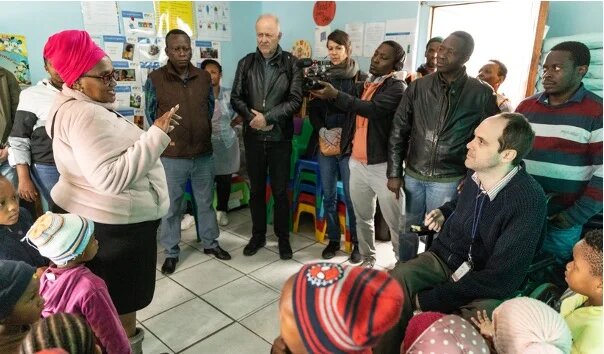
As Dr Wanga Zembe-Mkabile sat with an audience of residents, city officials and members of non-governmental organisations, she introduced her research on malnutrition by speaking about her experience as a mother and her efforts to provide a nutritious diet to her child. This marked the opening of the first food systems ‘learning journey’ in Langa, the oldest township of Cape Town, South Africa. It was followed by a series of walks, visits and group meals.
The philosophy underlying the journey is that a systemic transition needs an approach which integrates different perspectives on any urban system. Collectively, journey participants, who normally include residents, government officials, academics and practitioners, look at how the system interacts with the lives of people. By bringing together those with the power to make decisions at scale and those directly experiencing or responding to the issue, these experiential journeys focus on learning and formulating collective plans of action for change. Significantly, they also view those facing the brunt of urban issues as hosts or active informants in bringing about sustainable solutions to problems.
Bridging the Gap Between Theory and the Lived Experience
The in-depth immersions into different aspects of an urban system enable participants to engage with the physical space and people’s lived experiences through observation and conversation. The goal is to create a collective sense of the need for change – within and beyond the stakeholders directly involved - to identify strategies for affecting that change and to agree on a course of action. Ultimately, the aim is to find innovative ways to collaborate at the local level.
The learning journey process, which takes people out of their comfort zones challenges automatic assumptions. This has proven to be an effective means to 'flush out’ habitual thinking about problems so that innovative thinking around solutions can emerge. It is based on a long history of action research that has challenged preconceptions about who the 'experts' are. This pivots around collaborative learning that can, with concerted follow-up, result in locally appropriate, bottom-up systems change. By recognising that knowledge does not just reside with ‘experts’ but is also held by those formally or informally embedded in systems, the learning process embraces the full range of perspectives and opinions. With complex issues such as xenophobia, creating space for dialogue can lead to difficult conversations. When well-managed, this can result in the emergence of new thinking which recognises that what are often identified as problems are symptoms of failures within a system.
During a learning journey in Langa, a visit to one of the many informal Early Childhood Development (ECD) centres revealed the challenges of operating within an inflexible regulatory system. Law enforcement officials were in the process of dismantling part of the centre’s infrastructure due to zoning concerns. In a context where public and private land is often not clearly demarcated, demanding compliance with obsolete zoning regulations illustrated one way that informality is often punished. Ironically, such unregistered ECDs exist because public services are insufficient to meet the demand in the township. Seeing this first-hand provided a new common ground for officials, residents and academics to understand the cracks in the system.
The Journey is Not Without Risks
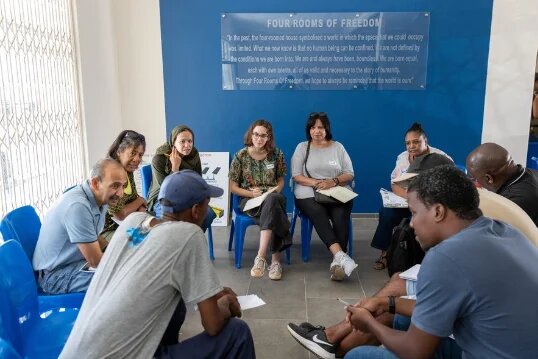
Residents, government representatives, academics and civil society members gather to discuss their reflections during a food learning journey held in Touws Rivier, Western Cape, in 2023 (Photo: Ashraf Hendricks).
One of the great strengths of the learning journey process is its ability to create spontaneous outcome. However, the structure of learning journeys must be carefully considered. Participants are selected to ensure broad representation and the spaces created for conversation need to be thoughtfully framed and managed to prevent them from being co-opted by those who may be more comfortable talking in public. Consideration should also be given to the risks of raising expectations, both of communities and government officials, who may struggle to fulfil the commitments that they make during the learning journey.
To sustain momentum beyond the learning journey, new insights and relationships must be combined with commitments to act. Participants are encouraged to publicly commit to taking action. This speaks to the critical importance of including participants in the learning journeys who have the power to have an impact on outcomes and make changes happen – both politically and technically. The broader goal is to move beyond learning about interventions or pathways for change and galvanise people into action through these processes.
Ethical issues must also be considered because learning journeys involve taking participants into spaces where people live and work, and where complex dynamics of power and privilege are at play. A deeply respectful approach is critical, and in some contexts, the learning journey approach may not be appropriate. For example, despite available resources, a journey was not pursued in the Breede Valley Municipality, one of the two secondary cities, due to ongoing community conflicts that had previously led to violence. Basic issues, such as ensuring the safety of participants, providing water in hot environments, and arranging safe transport, must also be considered.
Difficult conversations that may arise during these journeys need to be skilfully managed, while it is equally important to ensure that conversations do not end at the close of each respective journey. The question of ‘What happens now?’ must not be left unanswered. Organisers must ensure participants remain connected and engaged as they prototype and begin implementing the innovative solutions that have emerged, and continue to emerge, from ongoing dialogue.
A Multi-Purpose Tool
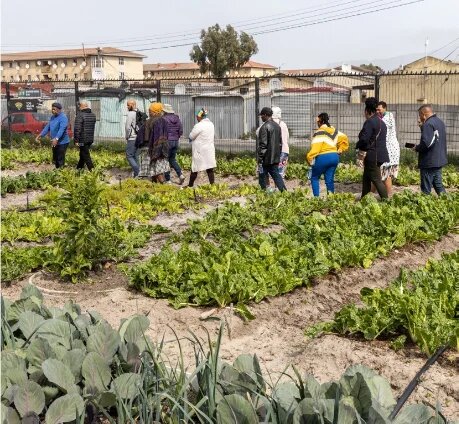
The learning journey is a powerful method for fostering dialogue, especially in situations where questions have become ‘stuck.’ By allowing people to step outside their established roles, it encourages experimentation with new ideas and, hopefully, inspires them to think differently.
Learning journeys can also help to guide research questions and agendas, ensuring that topics and findings respond to needs on the ground and not just academic imperatives. Working with the Breede Valley Municipality, for example, highlighted the desire to gather more data on the potential linkages between the food system and economic activities such as tourism when one city officials inquired about the possibility of further research.
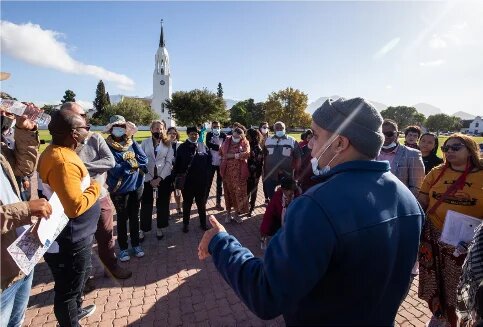
While the approach is time- and labour-intensive and requires the capacity for follow-up, this series of learning journeys has demonstrated the value of these interactive, participatory methods for joint problem-solving and policy implementation in African cities. Although mobilizing the necessary resources can be challenging, the method will continue to be pursued in efforts to improve food and other urban systems in South Africa. The series, initially focused on mapping food insecurity issues, revealed a host of interconnected challenges, including those related to the economy, mobility and social cohesion. These intimate encounters with the reality of the issue humanise statistics and balance power relations, revealing what cannot be seen at a distance.
The views and analyses expressed here are those of the authors and do not necessarily reflect the views of Heinrich-Böll-Stiftung.

