
Analyse
In early 2026, several thousand liters of drilling fluid leaked during a test drilling operation in the Amazon Mouth Basin. The project to extract oil off the coasts of Amapá and Pará is symbolic of Brazil's resource-driven development model, which continues to rely on large-scale agricultural, energy, and infrastructure projects.

The climate crisis calls into question the ideology that shaped government policies for the Amazon. There is the need to prioritize alternative conflict models with current developmentalist projects focused on commodity exports and oil exploration.
Despite the climate crisis, which imposes a sense of urgency on the planet, the Amazon continues to be viewed as a space to be occupied – a place for the conquest and intensive exploitation of natural resources and biodiversity. This ideology has formed the foundation for policies and plans across various governments and eras. It was the guiding conviction behind the “March to the West” program by President Getúlio Vargas during the New State period (1937–1945), and was later taken up by President Juscelino Kubitschek, who designed the Belém-Brasília Highway – approximately 2,000 km through the forest – to open the borders of the central-west region and achieve the definitive integration of the northern states into the market and development.This highway represented the main geopolitical project of Brazilian modernization. This model was later adopted by the military governments after 1964, with the construction of major highways linked to colonization and national integration programs. These government policies led to large-scale territorial interventions, reshaping the patterns of human occupation in the forest and altering economic and power structures. Notable examples include the National Integration Program, the Grande Carajás Program and the Polamazônia and Polonoroeste Programs, all of which received financial support through tax incentives aimed at livestock farming, agriculture, timber exploitation, and the establishment of mining complexes.
Hydropower expansion and the deepening of socioenvironmental conflicts
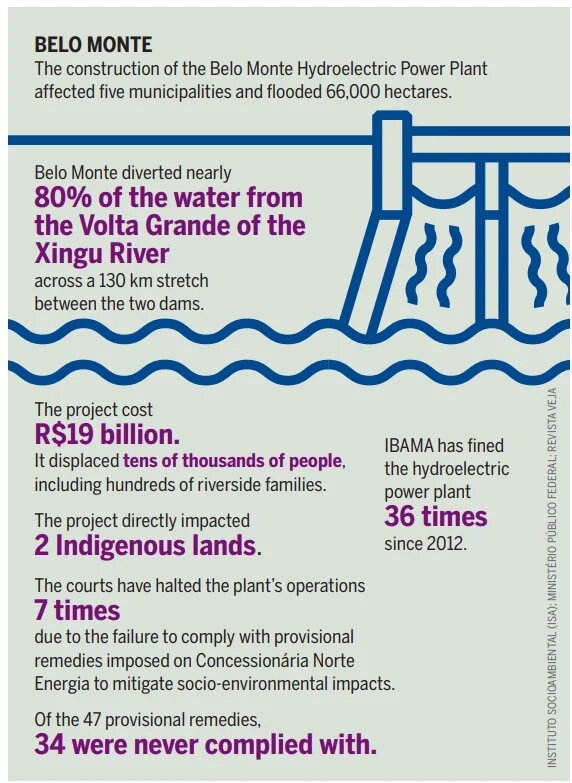
From the 1960s onwards, large hydroelectric power plant projects were implemented one after another. While energy production for various uses is essential, it is crucial to pursue techniques that minimize socio-environmental impacts. The Amazon hosts the largest group of large-scale hydroelectric power plants projects in the country, characterized by substantial financing, rapid transformation of the vast territories where they are installed, and significant socio-environmental impacts. The following major projects stand out: Tucuruí (1984) and Belo Monte (2016) in Pará; Balbina (1989) in Amazonas; Jirau (2013) and Santo Antônio (2016) in Rondônia; and Lajeado (2002) in Tocantins.
All of these projects faced strong opposition from social movements and environmentalists due to the socioenvironmental consequences they caused during various phases of implementation.
These impacts include the forced displacement of social and ethnic groups, intense migration of workers attracted to the construction sites, widespread unemployment in the post-construction period, a significant increase in lawsuits filed in Labor Courts, and greater demand and pressure on public services.
Additionally, there is deforestation, disruptions to the ecological and food chains of fauna, changes in the flora, and degradation in the quality of water and its flows.
Overwhelming scientific reports have challenged the social, environmental, and technical viability of projects such as Belo Monte and Balbina, two of the most emblematic cases. Indigenous peoples, quilombolas, riverside populations, and rural residents mobilized across various fronts. Although the conditions validated by the Prosecution Office were acknowledged, they were often disregarded in most legal proceedings, with procedural bias favoring environmental licenses.
Agricultural Frontiers, Soy Expansion, and Land Grabbing: The Growing Power of Corporations
The Amazon currently occupies a central position, serving as a convergence point for the interests of large corporations in the production chains of grains, meat, and ores. It has become one of the most important corridors for the export of agricultural and mineral commodities in Brazil. Soybean production is expanding across the Amazon states, rapidly driving the process of land succession. There is a noticeable increase in both national and international interest in acquiring land for large-scale grain production, with investments focusing on the futures market. This dynamic puts significant pressure on the land market, driving land deals and, most notably, land grabbing.
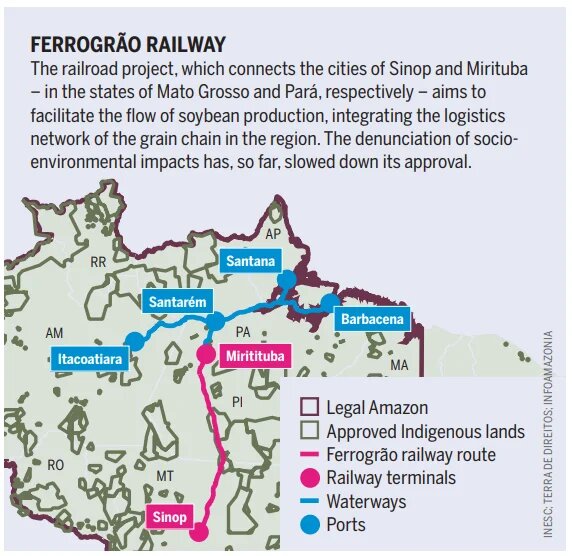
Massive public and private investments in infrastructure projects are being directed toward transportation, ports, transfer stations, roads, railways, and cold storage facilities. The New Growth Acceleration Program (PAC 3) continues to follow the ideals of developmentalist and modernization. One such project, the Ferrogrão railway (EF 170), crosses Indigenous lands and protected areas to facilitate the flow of agricultural commodities, particularly. Given the scale of the project, the resources provided by the federal government, and its potential to attract various agents and create conflicts, it is crucial to monitor and control deforestation induced by the project. This requires strengthening land and territorial planning in the region, along with ensuring social participation and community oversight.
In 2023, the Xingu+ Network highlighted the need to reassess the technical, economic, and environmental feasibility studies of Ferrogrão railway, as well as the socioeconomic studies. It also emphasized the importance of recognizing Free, Prior, and Informed Consultation and Consent as the mechanism to facilitate participation in decision-making processes.
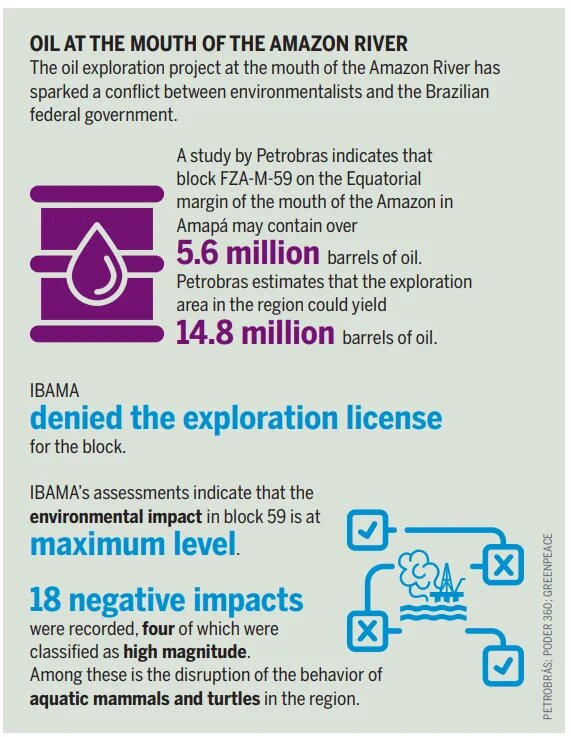
Finally, it is important to mention the oil exploration activities in the Upper Amazon region and along the Atlantic coast of Pará and Amapá. As of November 2024, following the research and prospecting phase, the project was in the auction and concession stage. The movement of geopolitical and economic interests, along with their alliances and strategies, particularly in a pre-COP 30 context, amid increasing extreme weather events worldwide and the urgent need for energy transition policies, raises important questions: Can we maintain the oil exploration model along the Amazon coast without irreversibly damaging the environment, especially considering the climate collapse we are already facing? What role should Brazil play in international climate negotiations?
It is also important to question the current infrastructure policy for the Amazon, which continues to be centered on large-scale construction projects. In recent decades, this policy has guided the trajectory and socio-economic dynamics of deforestation, as well as the mapping of conflicts. Understanding this situation, which stems from the hegemonic (and unsustainable) development model, requires political responsibility to urgently promote energy transition processes and value alternative experiences and models of organizing life with sustainability and socioenvironmental justice.
The article was first published in the Brazilian Amazon Atlas: https://br.boell.org/en/2025/06/10/brazilian-amazon-atlas
See the Portuguese Atlas version here: https://br.boell.org/pt-br/atlas-da-amazonia

