
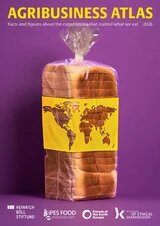
Agribusiness Atlas 2026

How did farmland turn into a factory, and how do pesticides banned in Europe still end up on our plates via the "boomerang effect"? When did seed copyright emerge, and is water being privatised as a resource? How can we cushion price shocks during crises and achieve food democracy for the many?
The Agribusiness Atlas 2026 these and other questions, revealing the extent to which food systems are dominated by powerful corporations. A handful of companies dictate prices, from seeds and pesticides to food retail, and exert massive influence over political decisions.
Covering topics ranging from agricultural markets, digitalisation and decarbonisation to nature credits and sugar, the Atlas uses data, facts, and numerous illuminating infographics to unpack a subject that affects us all every day. At the same time, it presents policy tools capable of curbing the market power and lobbying influence of these corporations.
Product details
Table of contents
02 IMPRINT
06 FOREWORD
08 12 BRIEF LESSONS ABOUT CORPORATE POWER
10 HISTORY HOW OUR FIELDS TURNED INTO FACTORIES
Today, just a handful of corporations determine what is grown in our fields, what ends up on supermarket shelves, and ultimately what we eat. This concentration of market power did not emerge overnight. As early as the 19th century, new machinery enabled the cultivation of ever larger areas of land with fewer workers. In the 20th century, the introduction of synthetic fertilisers and pesticides further accelerated this consolidation of power. Smaller farms came under increasing pressure, and so did the natural environment.
12 LOBBYING INDUSTRY SHAPES POLICY
Corporations and their lobby groups often enjoy privileged access to European and national policymakers. In terms of budget, the number of lobbyists, and meetings with officials, they greatly outnumber trade unions and civil society organisations which defend the public interest.
14 MEAT AND DAIRY COWS, CASH, AND CARBON
The world’s largest meat and dairy corporations emit as much greenhouse gas as entire countries and resist limits using fossil fuel lobby tactics. Data is key to accountability, but progress on reporting remains slow and under threat.
16 BLUE FOOD BIG FISHERIES TAKE OVER
A handful of corporations now shape what kind of fish and seafood reach dinner plates worldwide. The industry has grown more concentrated and industrialised, from Norwegian salmon farms to global supply chains. Aquaculture has surged, yet wild stocks remain under pressure as fleets push further offshore. The shift is changing who profits and at what cost to consumers and the environment.
18 WATER PRIVATISATION THIRST FOR PROFIT
Access to clean water has been a human right since 2010. Yet this vital resource is increasingly coming under corporate control. Across the world, corporations extract groundwater and spring water, selling it in branded bottles at prices that are often many times higher than those of tap water.
20 PESTICIDES EXPORTS DESPITE A BAN
Agrochemical corporations export pesticides that are banned in the European Union to countries where safeguards for health and the environment are weak. For BASF, Bayer, Syngenta and others, this is a lucrative business. For many people in the Global South, the consequences are severe.
22 SEEDS PLANTS UNDER COPYRIGHT CONTROL
Seeds form the foundation of our food supply. Yet they are increasingly controlled by a small number of multinational corporations. New genetic engineering techniques are accelerating this trend. Together, these developments are eroding biological diversity and pushing farmers around the world into ever greater dependence.
24 ANIMAL FEED THE POWER BEHIND SOYA
A small number of global players dominate the trade in animal feed, much of which is produced at the expense of rainforests, savannahs, and the rights and livelihoods of Indigenous communities. At the end of these supply chains, soya from corporations such as Cargill ends up in feed troughs on farms across Europe.
26 PRICE AND PROFIT HOW POWER SHAPES FOOD PRICES
How are food prices determined? How are profits distributed along the supply chain? For consumers, this is often quite hard to discern. Scientific studies consistently show that prices are rarely determined by supply and demand alone. Instead, they are shaped by power relations within the food system.
28 DECARBONISATION TRANSITION WITH PITFALLS
Our food system is exacting a heavy toll on the climate. Green hydrogen for fertilisers, agrofuels, and carbon farming are all touted as ways to reduce or offset emissions. Yet rather than delivering climate neutrality, these technical fixes often create new problems.
30 DIGITALISATION BIG TECH TILLS THE LAND
GPS sensors, cloud-based systems and artificial intelligence are fundamentally reshaping agriculture. A small number of corporations control the market and are pushing farms into ever greater dependence.
32 CHINA SOWING INFLUENCE IN GLOBAL MARKETS
During the 20th century, food systems globally were largely dominated by US multinational corporations and, to a lesser extent, European ones. In recent decades, this landscape has shifted, as Chinese corporations have steadily expanded their influence in agricultural trade and the agrochemical sector. Since many of these corporations are state-owned, their rise reflects not only market dynamics but also a deliberate government strategy.
34 NATURE CREDITS A RISKY MARKET APPROACH
The European Union (EU) is stepping up efforts to draw in private investment to meet its biodiversity and climate goals. This risks speculation, prioritises profitable projects over vital habitats, and reduces nature to tradable commodities.
36 UN FOOD AGENCIES FRAGMENTED GOVERNANCE AND CORPORATE POWER
The world faces rising hunger and ecological breakdown, driven by industrialised food systems. Yet no institution effectively guides global policymaking. Responsibility is split among competing agencies with overlapping mandates, rival funding, and weak oversight. The fragmentation of United Nations (UN) food agencies is a political choice that corporations exploit to reshape institutions for commercial interests.
38 PUBLIC GROCERIES HOW TO FIX A BROKEN MARKET
For millions of households in the United States, putting food on the table has become a daily struggle. Meanwhile, a handful of powerful suppliers dominate everyday staples such as eggs, soft drinks, beef, chocolate. By doing so, they reap enormous profits. One possible solution: public-sector stores that treat food not as a commodity but as a public good to make healthy, affordable food accessible to everyone. This idea could help reshape the food system.
40 PUBLIC PROCUREMENT THE PUBLIC PLATE’S UNTAPPED POWER
Public food procurement is largely driven by cost minimisation, reinforcing corporate concentration and the spread of ultra-processed foods. Brazil offers a different model, using public purchasing to support smallholder farmers and improve diets.
42 TERRITORIAL MARKETS THE FUTURE OF AFRICAN FOOD SYSTEMS
Across Africa, millions of people still rely on territorial markets rooted in local food cultures and informal trade. As food imports rise and ultra-processed diets spread, these food networks are not relics of the past, but essential to Africa’s future. Yet these systems are rarely in the focus of agricultural or investment policy.
44 FAIR PRICES FOR FARMERS WHEN PRICES FAIL TO SUSTAIN INCOMES
Deregulation of agricultural markets has led to volatile prices, unequal subsidies and farmers often selling below production costs. This undermines livelihoods and sustainable farming. Stronger European market regulation and fair pricing rules are needed to secure stable incomes and sustainability, and drive the much-needed agroecological transition.
46 PRICE REGULATION A SHIELD AGAINST CRISES
Wars and speculation are pushing up prices of agricultural commodities and food worldwide. Public buffer stocks for food can help cushion inflation and the impact of price shocks.
48 TO READ AND STUDY AUTHORS AND SOURCES FOR DATA AND GRAPHICS