Digital Streets: How Africa’s Youth Are Redefining Protest Published: 19 April 2026 Commentary Across Morocco, Kenya, and Madagascar, youth-led movements are challenging political power through decentralised leadership, street mobilisation, and cross-border solidarity. While digital tools help coordinate action, the protests reflect deeper frustrations over inequality, corruption, and political exclusion. Ester Pinheiro
Humour, hope and hashtags: how Gen Z is reshaping protest in Latin America Published: 18 April 2026 Commentary From livestreams in Lima to mass marches in Mexico City and youth networks in Buenos Aires, a new generation is reshaping protest in Latin America. Gen Z activists respond to corruption, crime, and political instability by blending street mobilisation with digital organising, memes, and cultural expression. Decentralised, creative, and often born online, their movements show how humour, hope, and hashtags are transforming activism across the region. Ester Pinheiro
Nigeria: “Continue to innovate and build alliances” Published: 22 September 2021 Interview The internet can open up spaces for marginalised groups to strengthen their identities, exchange ideas, form communities, and organise themselves. In Nigeria, however, freedom of communication and information is increasingly being restricted. We spoke with queer security expert Azeenarh Mohammed about LGBTIQ rights, risk profiles, and the Twitter blackout. Maria Kind
Zimbabwe: “You are the ones we have been waiting for” Published: 21 September 2021 Interview In the face of political oppression and persecution, the digital space offers many people in Zimbabwe the only lasting opportunity to exchange ideas and organise. We spoke with Fungai Machirori about the potentials and shortcomings of the internet, feminist digital activism in Zimbabwe, and the hopes placed in each new generation. Maria Kind
COVID-19: Tips for a Saner Digital Diet in These Viral Times Published: 4 March 2020 Article A virus riding on another virus. That is how the ‘infodemic’ is raging in online spaces around the outbreak of the novel coronavirus called COVID-19, which has been on just about everyone’s radar since late January 2020. As grave as the quest to manage the respiratory disease and cure those ill with it is not only the challenge of using facts versus fear - but how to create and keep avenues of information that withstand the unrelenting drip of skewed, confused, partially true to totally false information, to racist and prejudiced views, or a cocktail of these. Johanna Son
IT giants in China: a tough business Published: 14 February 2018 China suffers from draconian internet regulations, but enjoys a prosperous marketplace; it attracts IT giants from the United States and Europe, but it has also expelled some of them. Sophie Ping Sun
“Restricting women’s space on the internet is a violation of their rights” Published: 14 February 2018 Women in Pakistan face sexual harassment in public spaces and in the digital sphere. We talked with Nighat Dad, founder of the Digital Rights Foundation, about women’s experiences and how virtual abuse can be countered. Fabian Heppe
Who Cleans Up the Internet? Commercial Content Moderation and the Invisible CCM Workers of the World Published: 26 September 2016 Background Sarah T. Roberts
Digital Asia Published: 14 February 2018 Perspectives The latest Perspectives Asia edition covers the prozess of digitalization in Asia with contributions from all across the continent. Our online special presents all the articles with an additional podcast.
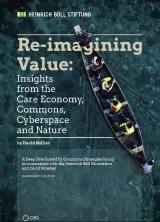
Re-imagining Value: Insights from the Care Economy, Commons, Cyberspace and Nature Published: 7 March 2017 What is valuable in society and how shall we protect it? This report, written by David Bollier, draws upon three days of discussion by twenty thinkers and activists convened by the Commons Strategies Group.
Audio: Youth Protests across Latin America From Colombo to Kathmandu to Jakarta, a generation raised online is turning digital outrage into real-world protest, challenging power, demanding accountability, and redefining what revolution looks like across Asia. In this podcast, the journalist Ester Pinheiro speaks with:
“Visions for a Digital Europe 2025” Online conference Published: 12 October 2021 Online conference How can we create a value-based European digital future that is innovative and internationally compatible at the same time? What influence can the EU have on the data-driven economy and digitised society through new legislative projects and further regulatory measures? These are some key questions debated at the online conference "Visions for a Digital Europe 2025", which took place on Wednesday 27 October 2021. An initiative of iRightsLab, the Heinrich Böll Foundation, the German Research Institute for Public Administration and the German University of Administrative Sciences.