

Women in a Moroccan desert oasis are defying a law that seeks to abolish their centuries-old right to the communal management of water distribution.
November 21, 2025, 5 p.m. As on every Friday, a long line of women sits on the ground along the ochre-colored walls of Figuig City Hall. Wrapped in the white of their haïks, woolen robes, these women have been the driving force behind a citizens’ resistance movement for two years: the Hirak al-Ma‘, Arabic for “water movement.” “The water of Figuig is not for sale,” they chant. And: “No to the company!” Amid the sea of white, 66-year-old Fatima carries memories of an oasis that the new generation knows only from the stories of their elders. Her eyes light up when she talks about her youth in the heart of the palm grove: “My childhood memories are inextricably linked to our gardens. There were wonderful pools and canals where we used to swim. Our childhood was marked by abundance and the sound of water.”
Figuig lies at an elevation of 900 meters in the far southeast of Morocco. It consists of seven villages spread over an area of 35 km² and has just over 10,000 residents. Figuig is a green island surrounded by mountains and bordered on three sides by Algeria. For centuries, people here have lived in an isolated world. They rely solely on themselves and the groundwater.
“Our water has always belonged to us,” says Naïma, a farmer who took over the family farm. “It was our ancestors who built the khettaras [underground irrigation systems]. If a company comes and takes our resource away, the oasis will disappear. We won’t let that happen. We’re fighting for future generations.”
The company the farmer is referring to is a government project. In 2023, the government passed Law 83-21, which provides for the establishment of regional companies (Sociétés Régionales Multi-services / SRM) to manage water, electricity, and wastewater. In Figuig, this decision was perceived as an attempt to strip the oasis of its identity. Here, water is not a commodity that can be managed by a company 400 kilometers away; it is the blood that flows through the veins of the palm grove, a common good made available by the hard work of the ancestors.
Water as Heritage
“The oasis is not a product of nature,” explains Majid Boudia. In 2022, the farmer and expert played a key role in getting Figuig’s recognized by the Food and Agriculture Organization of the United Nations (FAO) as part of the Global Agricultural Heritage System (SIPAM). “Our ancestors made use of sophisticated irrigation systems, groundwater, and the cultivation of palm trees and other species to transform this part of the desert into a habitat. This traditional knowledge, based on water management and solidarity, is crucial to our survival and our culture.” Historically, the oasis was far more than just an agricultural area: it was the economic heart of the desert, an indispensable hub for caravans, and a stop for pilgrims on their way to the holy sites.
The secret to Figuig’s survival cannot be seen; you have to hear it. Here, water gushes from 17 artesian wells with temperatures ranging from 31 °C to 37 °C.
Majid points out the Agoudass, a stone structure housing a water distribution system. The inhabitants of Figuig built it centuries ago. It looks like a clockwork made of stone, with bright blue-painted channels tracing a geometric pattern on the floor. In the Agoudass, Majid acts like a conductor. With the precision of a watchmaker, he manipulates the pebbles and cloths used to direct the flow of water. To gain more freedom, the Figuiguis have built about 200 storage basins. These reservoirs serve as regulators: they collect water at night to enable irrigation during the day. This way, water is available on demand. This system saves a lot of work: in the past, women had to carry 30-liter clay pots for miles to supply their families with water.
The drinking water network is the result of a collective pledge, a collaborative and communal effort
With the founding of the agricultural community in 1963, public wells were installed near the homes. Subsequently, a joint agreement between the community and the oasis residents enabled the construction of a drinking water network. This network was neither financed nor built by the central government. It is the result of a collective pledge, a collaborative and communal effort known as Twiza: each family “sacrificed” a portion of their private water rights for the common good, and each contributed according to their means to dig the ground, purchase the materials, and install the first faucets. By building their own infrastructure, the Figuigis established an inalienable right known as Haq l-ma, the right to water. To ensure the maintenance of the pipelines, the residents agreed to pay a symbolic fee to the municipality, which has committed to providing the oasis with roads, electricity, and infrastructure.
These efforts explain why, until today, the residents believe that the water belongs to them and not to the state. “In the oasis, we were raised to believe that water is precious, that you don’t waste anything, and that you reuse every drop. Over the centuries, this understanding of the resource has evolved into a culture of survival and created a social cohesion that persists to this day,” says Majid Boudia. Even the transition to a municipal city administration in 1994 did not end the social contract. Today, it forms the strongest bulwark against the reform. For Majid and his family, the principle is clear: what has been built communally cannot be privatized.
The Art of Scarcity
The conflict that divides Figuig today centers on a single piece of legislation: Law 83-21. For the authorities, the creation of regional water management companies (SRMs) represents an inevitable modernization of resource management. In the face of growing water scarcity, it is intended to prevent water from being wasted. For the people of Figuig, this represents a brutal break with a system of collective management that has always been regarded as an non-negotiable common good.
This bond has nothing sentimental about it, says Samira Mizbar, a social economist from Figuig. It is contractually regulated and legally unambiguous.
“The springs that supply Figuig belong to families. This right is enshrined in the official gazette,” the social scientist points out. “Every beneficiary is listed there with their exact share.”
Fatiha Kadi of the Water Movement believes that this resource comes with a duty to be vigilant: “The fact that we still have water today is no coincidence; it’s because we’ve mastered the art of scarcity. We live in harmony with the rhythm of the water. When it is abundant, we use it; when it becomes scarce, we conserve it.” She points out that the water travels phenomenal distances from the Atlas Mountains to reach this land, where the sky provides only 120 millimeters of rain per year. “Every drop that arrives here is a miracle that has crossed the mountains.“
Even though the SRM is presented as a national project to secure the water supply, doubts remain in the oasis. “We’ve known for centuries how to deal with water scarcity. If the government really wants to secure the water supply, why does it continue to allow the construction of wells and motor pumps?” asks Majid Bouida.
The entire natural balance of the oasis microclimate is at risk of collapsing.
Figuig sits atop an aquifer whose centuries-old balance is now threatened by the combined effects of climate change and overuse. In 2021, a report by the FAO revealed an alarming reality: within fifty years, seventeen of the oasis’s thirty-nine historic springs have dried up. The total available water supply has shrunk significantly—from 300 to 180 liters per second. According to Majid Boudia, this decline is not an inevitable consequence of climate change. “Certainly, climate change and drought play a role, but it is primarily human pressure that is destroying the oasis.”
The Struggle for Control
In 2010, construction began on the Sfissef Dam, 30 kilometers northwest of Figuig, which went into operation in 2015. By creating an illusion of security, it encouraged investment in palm varieties such as Mejhoul, which consume extremely large amounts of water. As soon as the drought had drained the dam, landowners turned en masse to groundwater. In 2021 alone, 1,338 wells were dug.
As the water level drops, an invisible enemy rises from the depths: salt, which could make the oasis gardens infertile for good. “With the loss of control over water, the entire natural balance of the oasis microclimate is at risk of collapsing,” says Boudia.
In fact, the palm groves in many of Morocco’s oases have been transformed into highly simplified agricultural systems as part of a trend of modernization.
While these may be potentially more productive, they are also more vulnerable to water scarcity.
To appease the Hirak movement, the authorities organized several meetings with its members. They explained that the SRM is a state-owned enterprise that plans neither to privatize nor to increase the prices. But the wording of the law speaks a different language. For example, Article 2 provides for the establishment of a public limited company (SA) under commercial law with an industrial purpose. It is intended to manage water resources in the future. Article 3 specifies that the capital may be opened to the private sector, provided that the state’s stake does not fall below ten percent.
“An SA is a business,” says Samira Mizbar, arguing that the government wants to turn water into a commodity that is billed. “That’s unacceptable, especially since a large portion of the population can’t afford it.” Faced with this impasse, the protesters have turned to the Kingdom’s Ombudsman’s Office. Even though no tangible results have been achieved so far, giving up is not an option. “Giving up would mean leaving Figuig. And that’s out of the question,” Samira emphasizes.
One Million Minutes of Resistance
The Hirak in Figuig started small. In October 2023, two days before the first vote on the implementation of Law 83-21 in the municipal council, six people demonstrated in front of City Hall. A young photographer live-streamed the sit-in on Facebook. Ultimately, the municipal council voted for joining the controversial SRM by a very narrow majority. Soon after, a sense of having been betrayed by politicians led to the creation of the local coordinating body for advocacy on matters concerning the Figuig oasis.
One of the water movement’s greatest achievements was breaking through Figuig’s geographical isolation by building national support alliances.
A coalition now includes 24 members, among them labor unions, human rights organizations, and feminist movements.
These supporters gathered at the oasis as part of a solidarity caravan that traveled from Casablanca through several cities to Figuig. They made it clear that Figuig’s problem is not a local dispute, but a matter of sovereignty and human rights.
Meanwhile, the water movement is making its voice heard at the national level: through a study meeting in the heart of parliament or at major national and international conferences on water scarcity and climate change. On September 26, 2025, the movement reached a staggering milestone: one million minutes of resistance—through sit-ins under the scorching sun or in the bitter cold of the mountains, through nighttime marches by the light of cell phone flashlights, or concerts with cooking pots.
Women are the true driving force: they are resilient, deeply rooted, and ready to do whatever it takes to protect our water.
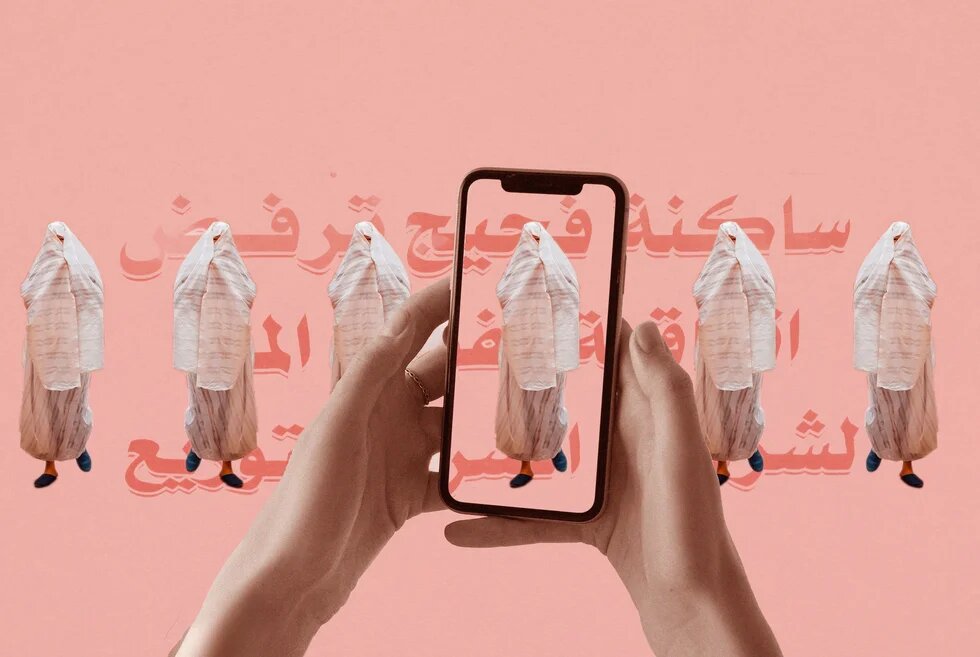
Women have always been at the forefront of this movement, wearing their traditional white robes. The haïk, which was once reserved for the elderly or for work in the fields, has become a powerful symbol for political communication. The garment serves as a reminder of past struggles, says Fatiha Kadi: “It is an echo of the resistance against colonialism and during the years of the ‘Lead Era.’” The women of Figuig have always been resistance fighters and a role model for all of Morocco, she adds. “By wearing the haïk, they protect their dignity in the face of what they call the new neoliberal colonialism.”
The role of women in the Figuig Hirak goes beyond their mere numerical presence; they are the true driving force. “I have always compared the women of Figuig to our palm trees,” says Zoubida Benali, a member of the Water Hirak coordination group. “The palm tree is incredibly resilient: it consumes only what is necessary to survive, yet is capable of spreading its roots over incredible distances to absorb even the slightest trace of moisture. The women here are just the same. They are resilient, deeply rooted, and ready to do whatever it takes to protect our water.”
The central role of women can also be explained by a demographic reality. As economic pressure drives men to migrate to the cities, women have become the pillars of the oasis economy—whether through agricultural work or business operations. Fatima Kandar, 63, embodies their perseverance. At the head of a wool cooperative and an association for the protection of cultural heritage, she uses poetry as a lever of resistance. “I’ve never seen the inside of a school, but the words know where to find me. The poems come to me all on their own. Thanks to the Hirak, my voice has been heard everywhere, and it won’t be silenced.”
A detailed version of the text in French is available on the website of the Heinrich Böll Foundation’s Morocco office.